Act I
“You break command equipment, you pay for it.”
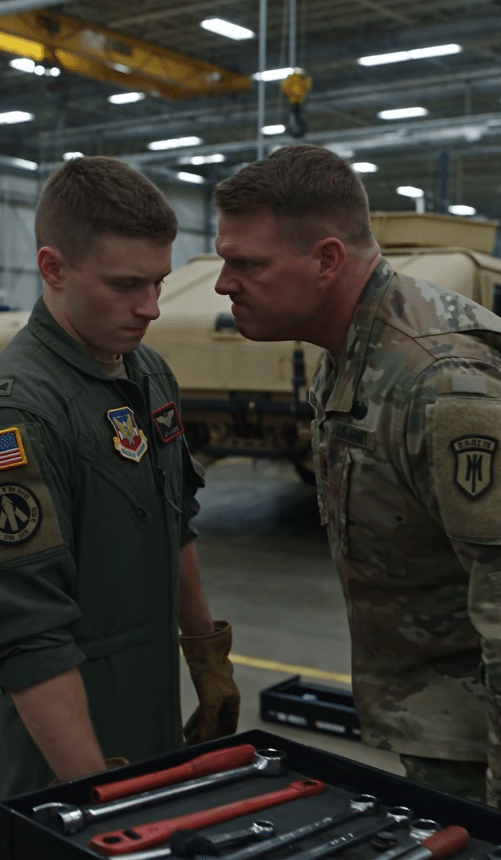
The Colonel’s voice cut through the motor pool, sharp enough to silence the mechanics working beneath the raised Humvees. A twenty-two-year-old Specialist stood beside a tactical vehicle, his gloved hands stained with engine oil, his eyes fixed on the concrete.
A diagnostic panel lay open behind him. The command vehicle had suffered a serious mechanical failure, and the Colonel had already decided who would take the blame.
The young mechanic swallowed. “Sir, I followed the maintenance checklist. The fault was already there when I opened the panel.”
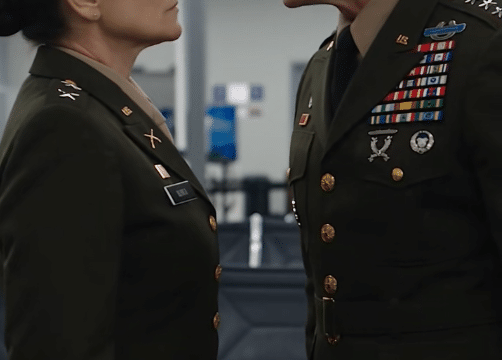
The Colonel stepped closer, his silver eagle insignia catching the overhead lights. At forty-seven, he was a large man accustomed to having the last word. He had built his reputation on discipline, but the soldiers under him had learned that his version of discipline often meant finding someone weaker to punish.
Before the Specialist could explain further, a woman in Army OCP uniform stepped between them.
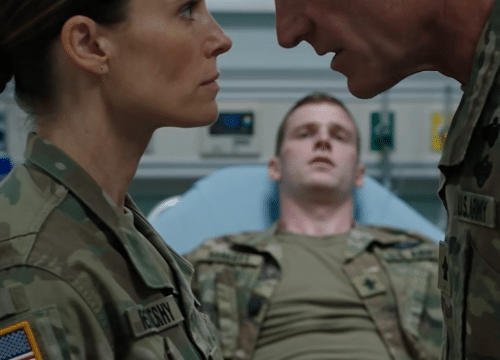
She was thirty-nine, with dark-brown hair secured in a low military bun and a field jacket slightly open at the front. Her expression was calm, almost unreadable. Nothing about her appearance demanded attention, and that was precisely why the Colonel underestimated her.
“He didn’t cause that failure,” she said.
The Colonel turned toward her slowly.
For a moment, he seemed more offended by the interruption than by the possibility that he had accused an innocent soldier. His eyes moved over her uniform, then settled on her face.
“Stay out of my maintenance line.”
She did not move.
The Specialist looked from one officer to the other, realizing that the situation had become much more dangerous than a damaged vehicle. The mechanics nearby stopped working. A Staff Sergeant at the far end of the maintenance bay watched without speaking.
The woman kept her eyes on the Colonel.
She had not come to the motor pool to embarrass him. She had come because the failure report did not match the inspection records, and because someone had to make sure a junior soldier was not punished for a mistake made higher up the chain.
But the Colonel had no intention of listening.
And when he realized she would not step aside, he made a decision that would destroy his career.
Act II
The failure had begun with a command vehicle that refused to start during a readiness check.
At first, it looked like an ordinary mechanical problem. The dashboard warning had appeared intermittently, then disappeared. A mechanic had logged the issue, but the vehicle had been returned to service after a quick review.
Now the fault had returned, and the Colonel was furious.
The vehicle was scheduled for an important inspection. Its condition reflected on his unit, and he had spent weeks telling his superiors that his maintenance operation was among the best in the command.
A failed command vehicle threatened that image.
The Specialist had been assigned to investigate it. He was young, conscientious, and still new enough to believe that doing everything by the book would protect him. He had followed the diagnostic procedure, documented the warning, and reported that the problem appeared to predate his work.
That should have been the end of the matter.
Instead, the Colonel accused him of damaging the equipment.
The woman had arrived earlier that morning as part of an independent inspection. Her assignment was not to help the Colonel defend his record. It was to determine whether the unit’s maintenance reports reflected the actual condition of its vehicles.
She had already noticed inconsistencies.
Several faults had been marked as resolved without convincing supporting documentation. Some maintenance entries had been approved unusually quickly. And the command vehicle’s history showed a warning that had appeared before the Specialist had even been assigned to the repair.
The young soldier was being blamed for something he could not possibly have caused.
She had seen this pattern before: a senior officer protecting a reputation by transferring the consequences downward. The junior soldier would receive the reprimand, the paperwork would be closed, and the person responsible would continue as though nothing had happened.
She refused to let that happen.
The Colonel, however, saw her intervention as a challenge to his authority.
He stepped toward her, his face tightening.
“You heard me,” he said. “Stay out of my maintenance line.”
The woman remained still.
Behind them, the Specialist looked as though he wanted to disappear. He had spent his entire career being told to respect rank, and now he was watching a senior officer openly threaten someone who had stepped forward to defend him.
The Colonel released the Specialist and turned fully toward the woman.
The mechanics sensed what was coming. One of them lowered his wrench. Another took a step back.
The Staff Sergeant started to move, then stopped.
No one wanted to believe the Colonel would cross that line in front of an entire maintenance bay.
But he did.
And the first strike came before anyone could intervene.
Act III
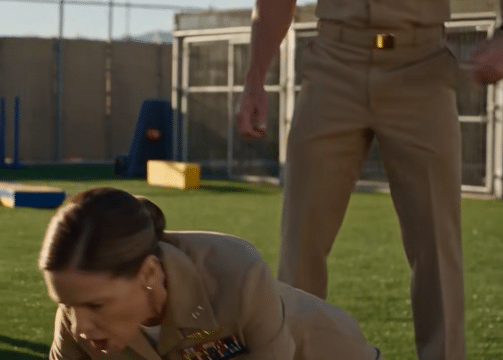
The slap cracked across the woman’s cheek.
Her head snapped sideways. For an instant, the motor pool seemed to lose every sound except the impact itself.
A red mark spread across her cheek, and a thin trace of blood appeared at the corner of her mouth. She steadied herself, but the Colonel gave her no time to recover.
He drove a hard kick into her abdomen.
She stumbled backward into a tool cart. Metal rattled violently as the cart rolled a short distance beneath the force of her fall.
Before she could regain her balance, he struck her upper body again, driving her shoulder into the cart. Tools spilled across the concrete, scattering beneath the maintenance equipment.
The Specialist froze.
A mechanic covered his mouth. Someone near the hydraulic lift took an instinctive step forward, but the Staff Sergeant raised a hand—not to protect the Colonel, but to keep the scene from becoming even more chaotic.
The woman bent slightly, one arm guarding her abdomen as she fought to draw a full breath. Her cheek was swollen and red. The faint blood at her mouth remained visible.
She did not beg.
She did not apologize.
And she did not look away.
The Colonel stood over her, breathing heavily. His expression carried the satisfaction of a man who believed he had restored control simply because he had hurt someone who challenged him.
“Stay out of my maintenance line,” he said again.
The woman slowly lifted her head.
There was pain in her eyes, but something else had replaced the surprise. Her expression had become colder, more deliberate.
The Colonel mistook her silence for defeat.
That was his second mistake.
The Staff Sergeant was no longer watching the Colonel’s face. He was looking at the woman’s uniform.
More specifically, he was looking at the rank patch.
At first, he seemed unsure of what he was seeing. His gaze moved from the insignia to her face, then back again. He had encountered senior officers before, but he had never expected to find one standing in the middle of his maintenance bay after being assaulted by a colonel.
The woman shifted her weight and slowly straightened as much as her injuries allowed.
The Staff Sergeant recognized her.
His posture changed immediately.
The Colonel noticed the movement but did not understand it. He glanced toward the Staff Sergeant, then toward the other mechanics, irritated that their attention was no longer fixed on him.
He still believed he was the most important person in the room.
Then the Staff Sergeant snapped to attention.
And raised his hand in salute.
Act IV
The salute changed the atmosphere instantly.
The woman stood beside the overturned tool cart, one hand still close to her abdomen. Her injured cheek was unmistakably red, and the small trace of blood at her mouth had not disappeared.
Yet the Staff Sergeant was not looking at her injuries.
He was looking at her rank.
A moment later, one mechanic followed his example. He straightened beside the Humvee and saluted. Another soldier stopped what he was doing, stood upright, and raised his hand.
Then the entire maintenance line followed.
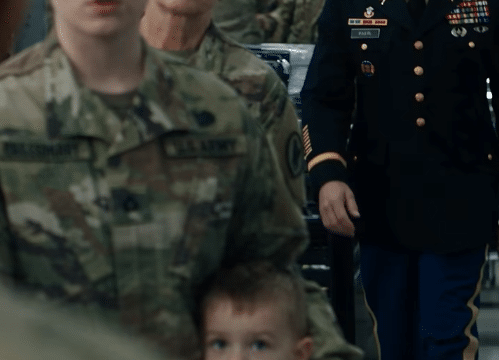
Mechanics stepped away from their workbenches. Soldiers emerged from between the tactical trucks. Even the Specialist, still shaken and oil-stained, came to attention.
One after another, they saluted the woman.
The Colonel turned toward them, confusion spreading across his face.
He looked at the Staff Sergeant’s rigid posture. He looked at the mechanics. Then he looked back at the woman.
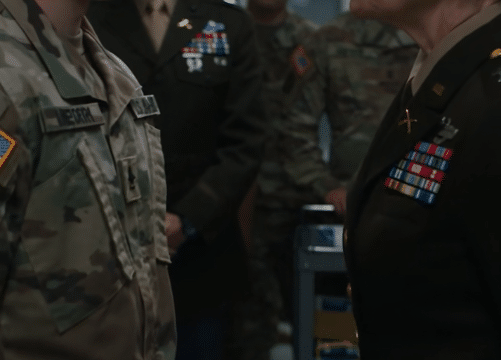
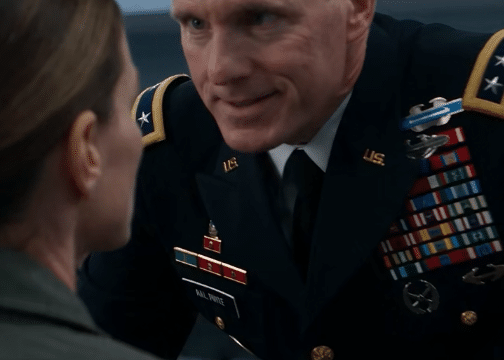
Her two-star rank patch was no longer something he could ignore.
She was a Major General.
Not a visitor who had wandered into his maintenance bay. Not an officer from another section whose authority he could dismiss. She was a senior commander conducting an independent inspection—and the person who had just watched him assault a junior soldier’s defender in front of witnesses.
The Colonel’s confidence began to collapse.
His jaw loosened. His shoulders shifted. The silver eagle on his uniform suddenly seemed less like a symbol of authority and more like evidence of the rank he had abused.
He tried to speak, but nothing came out.
The Major General held his gaze.
She had not needed to shout. She had not needed to announce her position. The soldiers had recognized her because they understood the insignia, the chain of command, and the responsibility attached to it.
The Colonel had spent the morning insisting that rank gave him the right to humiliate people.
Now the same system he had invoked was standing around him, silently acknowledging someone whose authority surpassed his own.
But the most damaging part was not that she outranked him.
It was that she had witnessed everything.
The accusation against the Specialist. The refusal to examine the evidence. The threats. The assault.
And every mechanic in the bay had seen it too.
The Major General slowly lowered her arm from her abdomen. Her breathing remained controlled, though each breath clearly cost her effort.
The Colonel looked from face to face, searching for someone who might still support him.
No one moved.
The Specialist stood at attention, his expression caught between disbelief and relief. For the first time that morning, he no longer looked like a soldier waiting to be punished.
He looked like someone who finally knew the truth would be heard.
The Colonel’s face grew pale.
He finally understood that the woman he had attacked was not powerless.
He had simply mistaken restraint for weakness.
Act V
The Major General took one careful step away from the tool cart.
The soldiers remained at attention. The Staff Sergeant held his salute, his expression firm. Around them, the motor pool had become completely still.
The Colonel stared at the two-star patch.
“Why are they saluting you?”
His voice was no longer commanding.
It was thin, uncertain, almost frightened.
The Major General did not answer immediately. She looked toward the Specialist first.
The young soldier still had oil on his gloves and stains across his sleeves. His eyes were fixed on her, but he did not seem to know whether he was allowed to relax.
She gave him a brief, steady look.
He had done his job. He had documented the fault. He had reported what he found. And he had been punished for refusing to accept blame for something that happened before he touched the vehicle.
That was the real failure in the motor pool.
Not the warning light. Not the damaged equipment. Not even the command vehicle that had refused to start.
It was a command climate in which a young soldier could be threatened for telling the truth, while the officer responsible believed his rank made him untouchable.
The Major General turned back toward the Colonel.
Her cheek remained swollen. Her mouth still carried the faint trace of blood. She was clearly hurt, but her posture was steady.
The Colonel’s eyes flickered toward the soldiers surrounding them. He seemed to realize that every person in the bay could describe what had happened. There would be no private version of events, no quiet conversation that could erase the evidence, and no easy way to turn the Specialist into the convenient explanation.
The inspection would continue.
The vehicle’s maintenance history would be examined. The original fault report would be preserved. The Specialist’s work would be reviewed against the records, and the Colonel’s conduct would be documented separately.
His assault would not become a disciplinary footnote hidden beneath a maintenance dispute.
It would become the central fact of the investigation.
For the first time that morning, the Colonel had nothing to order.
The Major General stood before him, surrounded by soldiers who had recognized her authority—and who had also witnessed what he had done.
She had entered the motor pool to protect the truth.
She left the Colonel with nowhere to hide from it.
And the young Specialist, who had arrived believing his career might be ruined over a mechanical failure he did not cause, finally understood something no maintenance manual could teach him:
A uniform carries rank, but it does not make a person right.
Sometimes the person with the greatest authority is the one willing to stand between a powerful officer and the soldier who cannot defend himself.
Align the draft with the 30-second formatRestore the exact approved dialogue