Act I
“Pilots sit in the back.”
The Major General’s voice cut through the aviation briefing room.
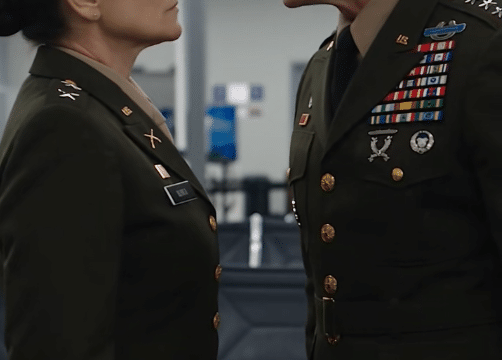
A woman in a military flight suit stood beside the command chair at the front of the room. Her brown hair was tied in a low bun, and her expression remained calm as she looked at the two-star officer standing between her and the seat.
Around them, several pilots were reviewing the upcoming mission on a large tactical screen.
The woman glanced at the command chair.
“That chair isn’t yours.”
The Major General turned slowly.
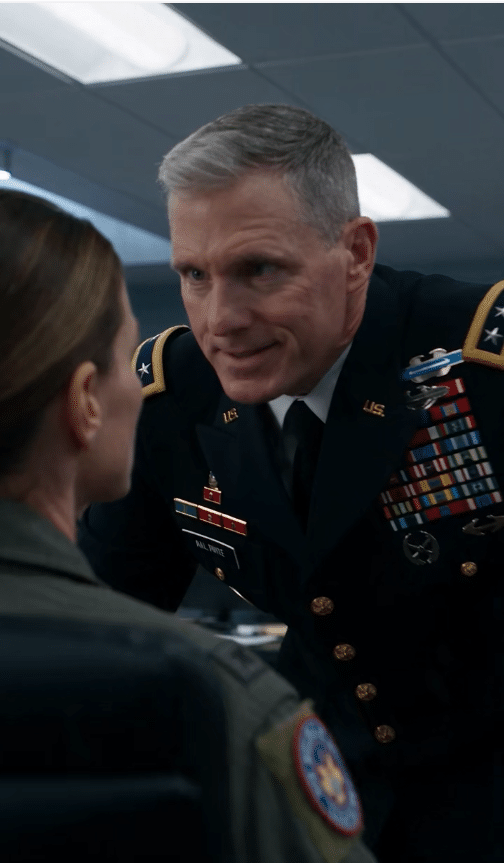
He was fifty, impeccably dressed in his Air Force service uniform, with two stars on his shoulders and a row of ribbons across his chest. He had spent years climbing the military hierarchy and had developed a particular dislike for anyone who challenged his authority.
Especially someone he assumed was merely another pilot.
“Now sit where you belong.”
A few pilots exchanged uncomfortable looks.
The woman didn’t move.
She had entered the briefing room to review the mission arrangements, not to compete over a chair. But the General had mistaken her quiet professionalism for weakness.
He stepped closer, his expression tightening.
He expected her to back down.
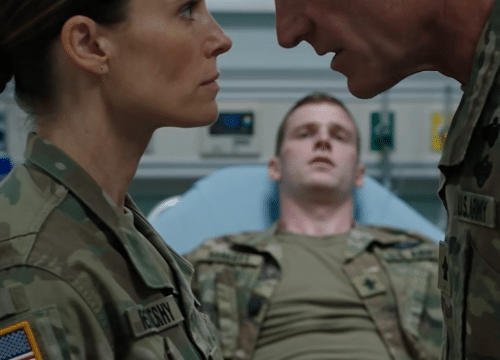
Instead, she looked him directly in the eyes.
And that was when his temper finally took control.
Act II
The General suddenly stood and struck her across the face.
The impact sent her stumbling sideways. Her cheek turned red almost immediately, and a faint trace of blood appeared at the corner of her mouth.
Before she could regain her balance, he drove a boot into her torso.
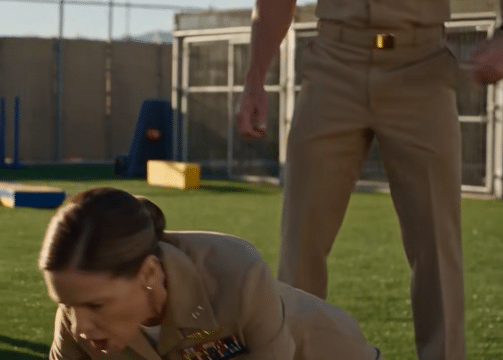
She fell beside the briefing table, struggling to catch her breath.
The pilots froze.
The General then turned toward the command chair and kicked it violently aside, sending it scraping across the floor.
“Now sit where you belong.”
His voice carried through the room.
He seemed satisfied.
In his mind, he had established the hierarchy. He had humiliated someone who dared challenge him, and everyone present had witnessed what happened when a person questioned his authority.
But the pilots weren’t looking at him the way he expected.
One had stopped writing.
Another stared at the woman on the floor, visibly struggling to understand what he had just witnessed.
The flight lead remained completely motionless.
The woman slowly raised herself onto one arm.
Her cheek was swollen. Her breathing was guarded, and she briefly pressed a hand against her injured side.
Yet she refused to lower her eyes.
The General looked down at her with an expression of absolute contempt.
He believed the confrontation was over.
He believed the command chair belonged to him.
What he didn’t realize was that the entire briefing room was about to discover whose name was actually attached to the mission.
Act III
For several seconds, nobody spoke.
Then the tactical screen behind the command table flickered.
The General barely noticed at first. He was still watching the woman, apparently expecting her to apologize or retreat.
But the flight lead had turned toward the display.
His expression changed.
A new command authorization had appeared on the mission interface. The briefing system was updating its command identification before the operational briefing could proceed.
The pilots began looking toward the screen.
Then the text became clear.
MISSION COMMANDER — LT. GEN. SARAH KELLER
Nobody moved.
The woman on the floor was Lieutenant General Sarah Keller.
At forty-four, she was an experienced aviator and the designated mission commander for the operation they were preparing to discuss.
Her authority wasn’t based on the fact that she could fly an aircraft or had spent years earning the respect of other pilots.
She was responsible for the mission itself.
Every major operational decision, every critical authorization, and every command responsibility ultimately connected to her position.
She had deliberately arrived without a formal introduction, wanting to review the briefing environment and observe how the team operated before the mission began.
The Major General had seen a woman in a flight suit and assumed she belonged somewhere in the back row.
He hadn’t bothered to check the command roster.
He hadn’t asked why she was standing beside the command chair.
And he certainly hadn’t imagined that the person he had just assaulted was the officer whose mission he was supposed to support.
The flight lead slowly stood.
He looked at her, then at the screen.
His posture became perfectly rigid.
And the next word he spoke would change the entire room.
Act IV
Every pilot immediately rose to attention.
The flight lead turned toward the injured woman.
“Ma’am.”
The single word carried more weight than anything the Major General had said during the confrontation.
The woman slowly pushed herself upright.
She briefly touched the corner of her mouth, wiped away the faint trace of blood, and straightened her flight suit.
Her movements were careful, but her expression was unmistakable.
The flight lead remained at attention.
The other pilots followed.
The Major General looked at the screen again.
Then at the woman.
Then back at the screen.
His face began losing color.
The command chair he had kicked aside was now sitting several feet away from its original position. The very seat he had tried to claim was intended for the person whose name was displayed behind him.
Sarah Keller took a slow step toward it.
Nobody attempted to stop her.
The General’s confidence began to crumble as he realized what had happened.
He had humiliated a senior officer in front of her own mission team.
He had struck the mission commander.
And he had done it while attempting to claim authority over a briefing that wasn’t his to control.
Sarah reached the chair.
She looked at it for a moment, then turned her eyes toward the General.
There was no satisfaction in her expression.
No smile.
No theatrical display of victory.
Only a quiet, uncompromising authority that made his earlier arrogance seem even more embarrassing.
The flight lead stood beside the table, waiting for her next instruction.
The entire room was waiting.
The Major General finally understood that the power he had tried to demonstrate had never belonged to him in the first place.
Act V
The room remained silent.
Sarah Keller stood beside the command chair, her swollen cheek visible beneath the briefing room lights.
The tactical screen continued displaying her name.
MISSION COMMANDER — LT. GEN. SARAH KELLER
The pilots stood at attention.
The flight lead maintained his position.
And the Major General looked as though someone had suddenly removed the ground beneath his feet.
He had spent years measuring people by their uniforms, their positions, and the number of stars on their shoulders.
He had assumed that a pilot in a flight suit could never hold more authority than an officer in a formal service uniform.
But Sarah Keller had not needed to announce herself.
The mission system had done it for her.
The General looked toward the chair he had kicked aside. His own behavior was now impossible to disguise as a misunderstanding.
He had attacked a senior officer over a seat.
A seat that had been assigned to the mission commander all along.
Sarah rested one hand on the back of the chair.
She didn’t shout.
She didn’t threaten him.
She simply looked at the man who had spent the last several minutes trying to make her feel small.
For the first time, he seemed unable to find a single commanding word.
His eyes moved toward the tactical screen once more.
Then he looked back at her.
His voice came out weak and uncertain.
“Mission commander…?”
Sarah held his gaze.
Behind her, the flight lead remained at attention.
The General’s face tightened as the full meaning of the revelation finally registered.
The woman he had ordered to sit in the back was the person who commanded the mission.
And he had just made the mistake of his career in front of every pilot who would be flying it.
Tighten the story to 30 secondsAlign the story with the timeline