Act I
“Give her the seat.”
The order came from a Brigadier General standing in the middle of a crowded military airport lounge. His twenty-four-year-old daughter waited beside him in civilian travel clothes, staring impatiently at the seat occupied by a wounded soldier.
The soldier was a twenty-eight-year-old Army Sergeant, recently returned from deployment. His left leg was supported by a brace, and his duffel rested beside his chair. He had been waiting quietly, trying to keep his injured leg comfortable while other passengers moved around the boarding area.
The General expected him to move.
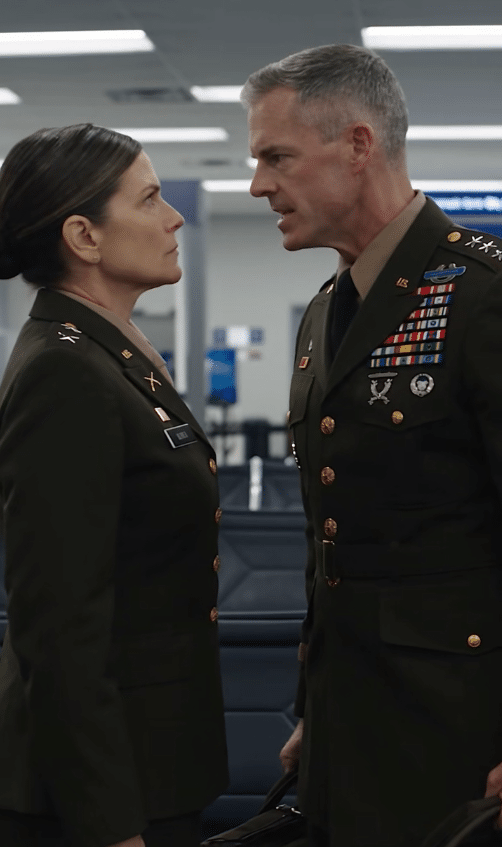
But a woman in an Army service uniform stepped forward. Her dark hair was secured in a neat military bun, and two stars marked her rank insignia.
“No. He stays seated.”
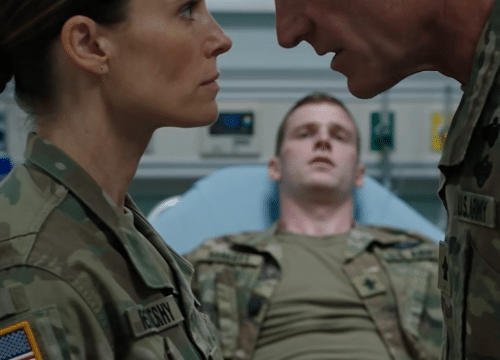
The Brigadier General turned toward her, his expression hardening.
“You don’t decide what my family gets.”
She did not argue. She simply stood between him and the wounded Sergeant.
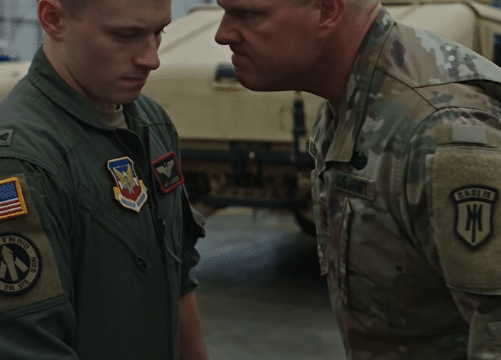
The General seized the Sergeant’s duffel and threw it onto the floor. Then he turned and struck the woman across the face with a brutal slap.
Her head snapped sideways. A red swelling appeared on her cheek, and a faint trace of blood marked the corner of her mouth.
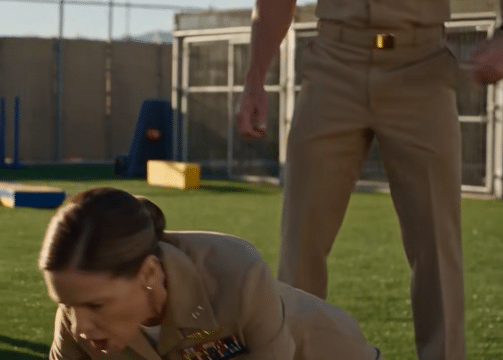
Before she could regain her balance, he drove a hard kick into her abdomen, knocking her backward. A second strike to her upper body sent her crashing into a row of airport seats.
The lounge fell silent.
The wounded Sergeant stared in disbelief. His duffel lay several feet away, and the woman who had defended his seat was struggling to stand.
The Brigadier General remained convinced that he had won.
He had no idea whose aircraft was waiting at the gate.
And the next announcement would change everything.
Act II
The military airport lounge was designed for people who had already spent too much time waiting.
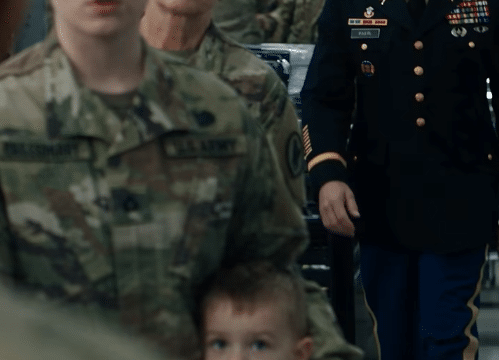
Soldiers returning from deployment sat beside families traveling across the country. Uniformed personnel checked boarding information while civilian passengers moved between rows of seats and luggage carts.
For the wounded Sergeant, the chair had been more than a convenience.
His left leg had not fully recovered from an injury sustained during deployment. The brace helped him walk, but standing for long periods caused pain. He had been instructed to avoid unnecessary strain while traveling.
He had not complained.
He had not demanded special treatment.
He had simply taken an available seat and waited for boarding.
The Brigadier General’s daughter, however, wanted that exact chair.
She was twenty-four, dressed for civilian travel, and accustomed to having her father’s position open doors for her. When she noticed the Sergeant sitting there, she expected him to move.
Her father immediately supported her.
He did not ask whether the soldier was injured. He did not check whether another seat was available. He simply ordered the Sergeant to give it up.
The General had spent years in an institution where rank mattered. That was not the problem. Military hierarchy existed for a reason, and discipline was essential to keeping soldiers alive.
The problem was that he had begun treating rank as a private family benefit.
His daughter wanted something, so someone else had to surrender it. His authority became the explanation for every demand, even when those demands had nothing to do with military necessity.
The woman who intervened understood the distinction.
She was a forty-year-old Major General, a senior officer in the Army. Her service uniform carried two stars and restrained decorations, but she had not entered the lounge expecting anyone to recognize her.
She had noticed the wounded Sergeant struggling to keep his leg comfortable. She had also noticed the General’s daughter pointing toward his seat.
When the General ordered the soldier to move, the Major General stepped forward.
“No. He stays seated.”
It was a simple statement.
The Sergeant needed the seat. The daughter could find another place to wait. There was no legitimate reason to make an injured soldier suffer for someone else’s convenience.
But the Brigadier General heard something entirely different.
He heard a challenge.
And instead of reconsidering his demand, he chose to make an example of the woman who had opposed him.
Act III
The attack happened so quickly that several passengers did not understand what they had witnessed until it was over.
The General threw the Sergeant’s duffel onto the floor.
Then he slapped the Major General across the face.
The impact echoed through the lounge. Her cheek reddened and began to swell, while a small trace of blood appeared at the corner of her mouth.
He followed with a forceful kick to her abdomen.
She stumbled backward, losing her balance as she was driven away from the Sergeant. Before she could steady herself, another hard strike to her upper body sent her into the row of seats.
A boarding announcement continued faintly in the background.
Nobody moved.
The wounded Sergeant looked from his fallen duffel to the woman who had defended him. He wanted to stand, but his injured leg made the movement difficult.
The Major General remained conscious.
She drew a careful breath and slowly pushed herself upright. Pain showed in her face, but she did not beg or retreat.
The Brigadier General stood over her with the confidence of a man who believed the confrontation had ended in his favor.
His daughter watched from nearby.
Whatever she had expected when her father demanded the seat, it could not have been this. The lounge was no longer looking at an ordinary disagreement between travelers. Everyone had seen a senior officer assault another uniformed woman because she refused to surrender a seat belonging to an injured soldier.
The Major General’s swollen cheek and guarded posture made the cost of that decision impossible to ignore.
Yet she did not turn the moment into a personal argument.
She looked toward the Sergeant first.
His duffel was still on the floor. His injured leg was still braced. He was still the person who had needed protection before any of this began.
The General had tried to make the confrontation about his family.
She had kept it about the soldier.
Then a boarding officer approached the gate with a manifest tablet.
He checked the information on the screen.
His eyes moved toward the woman standing beside the seats.
And his entire posture changed.
Act IV
The boarding officer stopped.
He looked down at the manifest tablet again, then raised his eyes toward the Major General. The recognition was immediate.
He stood at attention.
“General, your aircraft is ready.”
The words carried across the quiet lounge.
Behind him, the gate staff straightened as well.
The Brigadier General turned toward the boarding officer.
For a moment, he seemed unable to understand what he had heard. His eyes moved from the officer to the woman he had just attacked, then back to the tablet.
The woman was not merely another passenger in uniform.
She was the senior commander whose aircraft was being prepared.
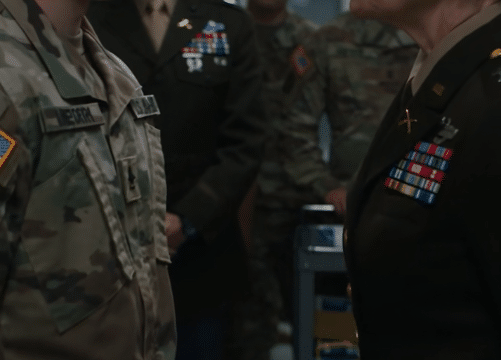
The two stars on her uniform had been visible throughout the confrontation. The Brigadier General had simply been too consumed by his own authority to recognize what they meant.
His expression began to change.
The confidence that had carried him through the assault disappeared. His jaw loosened, and a sheen of sweat formed along his face.
The boarding officer remained at attention.
The gate staff did not look toward the Brigadier General for permission to show respect. Their attention was fixed on the Major General.
The wounded Sergeant watched the scene unfold.
Only moments earlier, he had been ordered out of his seat so the Brigadier General’s daughter could have it. His duffel had been thrown to the floor, and the woman who defended him had been struck and kicked in front of the entire lounge.
Now the officer who had attacked her was standing in front of a commander whose authority extended far beyond his own.
The Major General did not smile.
She did not need to.
Her injuries remained visible. Her cheek was swollen, and she continued to protect her abdomen as she stood. But she met the boarding officer’s recognition with the same controlled dignity she had shown before the assault.
The Brigadier General finally understood that he had misjudged the situation.
He had assumed that the woman could be intimidated because he believed himself to be more powerful.
He had never considered that she might be the person with greater authority.
And now the entire gate area knew it.
Act V
The Brigadier General stared at the Major General.
His eyes moved toward the boarding officer, then back to the woman standing beside the seats.
“Your aircraft…?”
The question came out almost as a whisper.
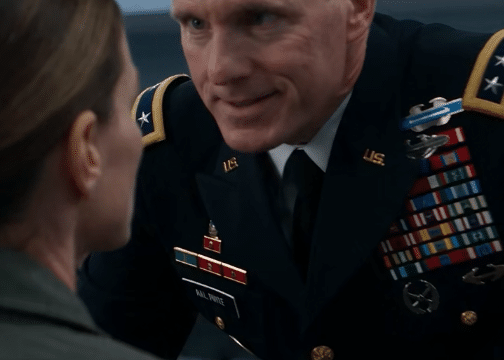
The arrogance had vanished from his face. His posture, once rigid with entitlement, now looked uncertain. The one-star insignia on his uniform remained exactly where it had been, but it no longer seemed to offer him the protection he had expected.
The Major General stood quietly.
She had not demanded that anyone give her a seat. She had not asked the Sergeant to move for her. She had not used her rank to make the lounge revolve around her needs.
She had defended a wounded soldier who could not easily stand.
That was the difference between the two officers.
One had treated authority as a privilege to be used for his family. The other had treated it as a responsibility to protect people who needed support.
The Sergeant looked down at his duffel, still lying on the floor. His injury had not disappeared, and the embarrassment of being treated as though his needs did not matter had not vanished either.
But someone had stood up for him.
The Brigadier General’s daughter remained beside the gate, no longer focused on the seat. She had watched her father use violence to get what she wanted, only to discover that the woman he attacked was the senior commander whose aircraft was waiting.
The boarding officer continued to stand at attention.
The gate staff remained straight and silent.
And the General had to face the fact that everyone in the lounge had seen what he had done.
The seat had never been the real issue.
It was about whether a wounded soldier deserved dignity, whether a family connection could override fairness, and whether rank gave anyone the right to treat another human being as disposable.
The Major General had answered those questions without raising her voice.
The Brigadier General had answered them with his fists.
Now, as the boarding officer waited for his commander, the man who had demanded that everyone make room for his daughter could only stare at the aircraft that was waiting for the woman he had just attacked.
Remove the long-form backstory and keep only the 30-second scene