Act I
“You just ruined my shirt.”
The Colonel’s angry voice echoed through the small roadside diner.
A silver-haired waitress stood beside his booth, holding an empty coffee pot. Her pale-blue shirt and white apron were stained with the coffee she had accidentally spilled moments earlier.
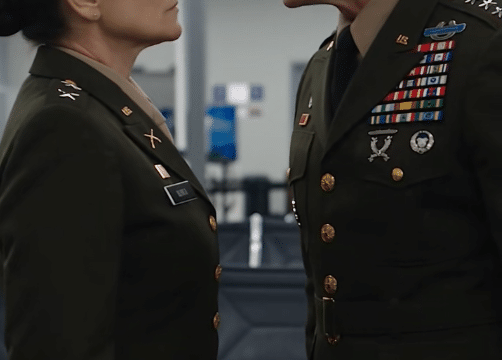
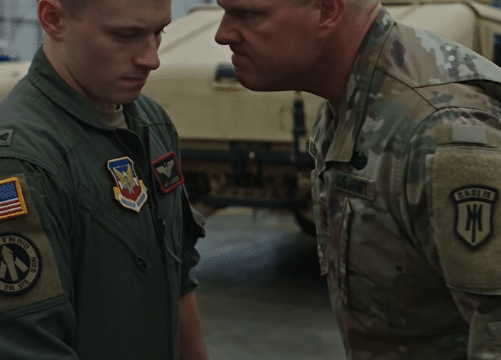
The officer was forty-five, dressed in a perfectly pressed U.S. Army service uniform. His silver eagle insignia, ribbon rack, and nameplate were clearly visible.
He looked at the woman as though she had committed an unforgivable offense.
She glanced at the stain and immediately reached for a towel.
“It’s coffee. I’ll bring a towel.”
Her voice was polite.
She was sixty-six years old, with silver hair tied neatly behind her head and the tired expression of someone who had spent decades working long shifts to pay her bills.
But the Colonel wasn’t interested in an apology.
He wanted an audience.
“You just ruined my shirt,” he repeated, looking around as though expecting the other customers to share his outrage.
The waitress quietly reached for the coffee pot.
Then the officer did something that made the entire diner freeze.
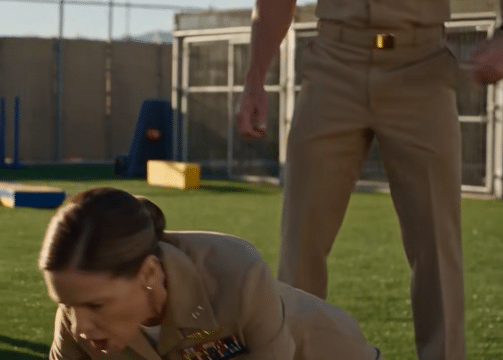
He grabbed the remaining coffee and threw it directly into her face.
Before she could recover, he slapped her hard across the cheek.
Her head turned sharply. She stumbled backward, and a small trace of blood appeared at the corner of her mouth.
Then he kicked her in the torso.
She fell beside the red vinyl booth, knocking against the edge of the seat as the coffee pot rolled across the floor.
A truck driver stood up.
A young couple near the window gasped.
But the Colonel wasn’t finished.
He reached into his pocket, pulled out several dollar bills, and threw them onto the floor beside her face.
“Clean yourself up with the tip.”
The waitress slowly raised her head.
Her cheek was swelling. Her uniform was soaked. Her breathing was uneven.
But she didn’t beg.
She didn’t cry.
She looked at the officer with an expression that made his satisfaction seem suddenly ugly.
He had just humiliated a hardworking waitress in front of an entire diner.
What he didn’t know was that the woman on the floor was the mother of a man who outranked him.
And that man was only minutes away.
Act II
Her name was Margaret Hayes.
Most customers simply called her Maggie.
For nearly twenty years, she had worked at the little roadside diner along Interstate 40. She knew which truck drivers preferred black coffee, which elderly customers needed help carrying their groceries, and which families stopped every Friday on their way to visit relatives.
She remembered birthdays.
She kept spare change for customers who occasionally came up short.
And when a young soldier passed through town on leave, she often slipped an extra piece of pie onto his bill without mentioning it.
She wasn’t wealthy.
She didn’t own the diner.
She didn’t have a large house or expensive jewelry.
But she had something she considered far more important.
She had raised a son who had devoted his life to serving his country.
Her son was Daniel Hayes.
He had grown up in a modest home, watching his mother work long hours and come home with aching feet. When his father died, Margaret took extra shifts to make sure Daniel could finish school.
She never told him how difficult those years had been.
When he decided to join the military, she supported him, even though the thought of him leaving terrified her.
Daniel rose through the ranks over the following decades.
He served in difficult assignments, commanded soldiers, and eventually became a Major General in the United States Army.
But despite his rank, he never forgot where he came from.
He still called his mother every Sunday.
He still asked whether she was eating properly.
And whenever he returned home, he insisted on visiting the little diner where she worked.
Margaret had never used her son’s position to demand special treatment.
In fact, she rarely mentioned his rank.
She liked being Maggie.
She liked pouring coffee.
She liked knowing that ordinary people felt comfortable sitting in her section.
That morning, Daniel had arranged to visit her after completing an official military engagement nearby.
He had planned to arrive with several officers, surprise her, and take her to lunch.
Margaret had been looking forward to seeing him.
Instead, she was lying on the floor beside a booth, staring at the dollar bills scattered near her face.
The Colonel adjusted his uniform.
He seemed pleased with himself.
He had no idea that the waitress he had just assaulted had spent decades teaching a future Major General that leadership meant protecting people who couldn’t protect themselves.
And now, that lesson was about to return to the diner.
Act III
The first warning came from outside.
Several black military vehicles approached the diner and braked near the entrance.
The truck drivers looked through the windows.
A moment later, the door opened.
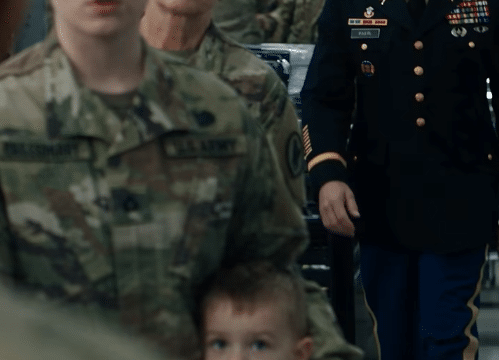
Five uniformed officers entered behind a decorated senior military figure.
His face remained hidden from view.
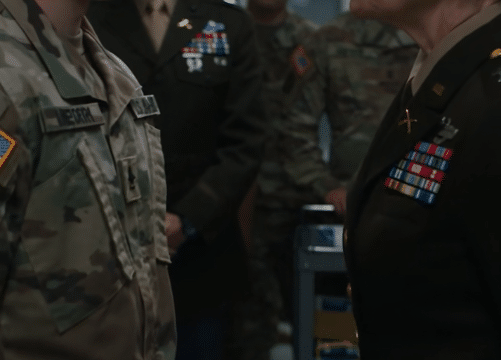
The camera captured only his formal uniform, decorated shoulders, two-star insignia, dense rows of ribbons and medals, polished belt, and immaculate military boots.
The atmosphere changed immediately.
The officers accompanying him moved with purpose.
Customers stepped aside as the group crossed the small dining room.
The Colonel turned toward the entrance.
His irritation quickly gave way to uncertainty.
He recognized the significance of the approaching uniform.
The two stars on the senior officer’s shoulders represented a rank considerably above his own.
Instinctively, the Colonel straightened his posture.
He adjusted his collar and attempted to restore the confident expression he had worn moments earlier.
But the senior general didn’t stop to acknowledge him.
He walked directly toward the fallen waitress.
One of the accompanying officers moved ahead, looking down at Margaret.
The senior general stopped beside her.
For a moment, he said nothing.
He looked at the coffee covering her pale-blue shirt.
Then at her swollen cheek.
Finally, his attention moved to the dollar bills scattered across the floor.
His posture changed.
The officers behind him became completely still.
Margaret slowly looked up.
Even through the pain, she recognized the familiar uniform.
She didn’t call out.
She didn’t explain what had happened.
She simply looked at the man standing in front of her.
The Colonel noticed that exchange.
Something was wrong.
The senior general wasn’t treating the woman like an ordinary stranger.
He was looking at her with the kind of concern that couldn’t be explained by professional courtesy alone.
The Colonel glanced at the senior officer’s insignia.
Then at Margaret.
He tried to understand the connection.
And then the senior general turned toward him.
His voice was controlled, but the question that followed made every customer in the diner go silent.
Act IV
“Who put her on that floor?”
The question landed like a verdict.
The Colonel froze.
He looked at the senior general, then at Margaret.
For the first time, he seemed genuinely uncertain about what to say.
The senior officer didn’t shout.
He didn’t need to.
One of the accompanying officers immediately moved to help Margaret sit upright. Another retrieved a clean towel from behind the counter.
The general remained beside her.
The Colonel’s eyes shifted toward the two stars on the senior officer’s shoulders.
Then he looked down at the dollar bills he had thrown onto the floor.
Suddenly, those few pieces of paper seemed more humiliating than anything else in the room.
The truck driver who had stood up earlier stepped forward.
He pointed toward the Colonel and indicated that he had witnessed the entire assault.
The young couple near the window still had their phones out.
The diner owner had already begun preserving the security footage.
There would be no opportunity to rewrite the story.
The Colonel’s mind raced.
He had assaulted a civilian.
He had thrown coffee into an elderly woman’s face.
He had struck her, kicked her to the floor, and thrown money at her as though she were someone beneath his attention.
But there was another detail he still hadn’t fully understood.
Margaret Hayes wasn’t simply an innocent waitress who had been unlucky enough to encounter an arrogant officer.
She was the mother of Major General Daniel Hayes.
The senior officer standing beside her was her son.
He had arrived expecting to take his mother to lunch.
Instead, he had found her injured on the floor, surrounded by witnesses and scattered dollar bills.
The Colonel’s face began to lose its color.
His eyes moved from the general’s insignia to Margaret’s face.
He remembered the woman’s calm voice.
Her simple offer to bring a towel.
The way she had never raised her voice or insulted him.
And he realized that the person he had treated as worthless was someone whose family had given an extraordinary part of their lives to the country he claimed to serve.
But the general wasn’t finished.
He turned slightly toward his accompanying officers.
The assault would be documented. Witness statements and security footage would be preserved. The appropriate authorities would be notified, and the Colonel’s conduct would be subject to formal investigation.
His rank would not shield him from accountability.
Not this time.
Act V
The diner had become completely silent.
Margaret sat beside the booth while an officer helped her hold a clean towel against her injured cheek.
Her breathing was still uncomfortable, but she remained composed.
Daniel stood beside her.
His decorated uniform looked almost out of place in the little roadside diner where his mother had spent so many years pouring coffee and washing dishes.
He looked at her injured face.
Then at the scattered money.
For a brief moment, the general’s controlled expression gave way to something deeply personal.
This wasn’t an incident involving a stranger.
This was his mother.
The woman who had worked double shifts when he was a child.
The woman who had quietly sacrificed her own comfort so he could pursue his future.
The woman who had never asked him to use his rank to make her life easier.
He turned toward the Colonel.
There was no need for a dramatic speech.
The evidence was everywhere.
The coffee-stained floor.
The overturned pot.
The dollar bills.
The witnesses.
And the elderly waitress sitting beside the booth with a swollen cheek.
The Colonel’s own uniform suddenly seemed to weigh heavily on him.
He looked at Daniel’s two stars.
Then back at Margaret.
His confidence disappeared.
His jaw loosened, and sweat began forming along his forehead.
He finally understood why the senior general had walked past everyone else to reach the waitress.
Why five officers had followed him.
And why the entire room had gone silent.
The woman he had humiliated wasn’t just someone’s mother.
She was the mother of the commanding officer standing directly in front of him.
The Colonel tried to speak.
But his voice failed him.
“Sir… she is…?”
He couldn’t finish the sentence.
The camera held on his pale, terrified face before cutting to black.
For years, Margaret Hayes had served strangers without expecting recognition.
She had poured coffee for soldiers, truck drivers, families, and people who would never know her name.
And when someone finally treated her with cruelty, she still hadn’t begged for respect.
Her son didn’t need to remind anyone of his rank to understand what had happened.
Because the greatest measure of a military uniform isn’t the number of stars or ribbons attached to it.
It’s how its wearer treats the people who have none.
Tighten the middle and endingAdd stronger dialogue for Daniel