Act I
“This line is for command guests.”
The Brigadier General’s voice carried across the crowded military charity expo.
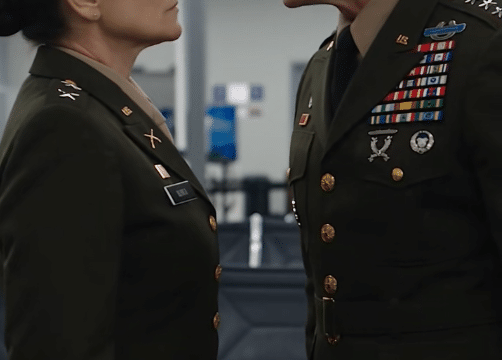
He stood beside the priority entrance, his immaculate Army dress uniform covered in ribbons and service decorations. The single silver star on his shoulder was clearly visible as he blocked an elderly man from entering the reserved section.
The older gentleman wore a dark suit, a white shirt, and a light-gray tie. His silver hair was neatly combed, his polished shoes looked almost new, and his right jacket sleeve had been carefully tailored around an amputated forearm.
He looked at the officer without raising his voice.
“I was invited here.”
The General glanced at the invitation in the man’s remaining hand but made no effort to examine it.
His eyes moved instead to the empty right sleeve.
“You don’t look like command.”
A few people nearby exchanged uncomfortable glances.
The charity expo had been organized to honor wounded veterans, raise money for military families, and celebrate those who had sacrificed their lives and health in service to the country.
Yet here was a uniformed officer publicly judging a veteran by his appearance.
The elderly man remained calm.
He had no intention of arguing over his dignity.
But the Brigadier General interpreted his silence as defiance.
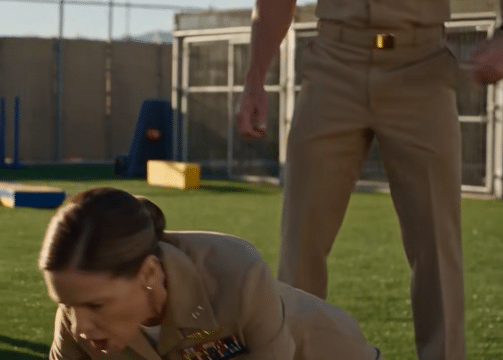
Without warning, he stepped forward and punched the older man across the face.
The impact sent his head sideways. His cheek immediately reddened, and a small trace of blood appeared at the corner of his mouth.
Before anyone could intervene, the officer stepped back and drove a powerful kick into the man’s chest.
The elderly veteran staggered backward.
With only one fully functional arm, he couldn’t properly break his fall. His shoulder and side struck the polished expo floor.
A donation brochure scattered beneath him.
A woman near the registration counter screamed. Several guests rushed forward, but stopped when they saw the officer standing over the fallen man.
The Brigadier General looked down at him.
He had just assaulted an elderly man at an event created to honor wounded veterans.
And he still believed he was the most powerful person in the room.
He was about to learn otherwise.
Act II
The charity expo had been one of the most anticipated military events of the year.
Hundreds of veterans, active-duty personnel, military families, and civilian donors had gathered inside the convention hall. Booths displayed rehabilitation equipment, adaptive technology, and programs designed to help wounded service members rebuild their lives.
At the center of the hall stood a large stage decorated with American flags.
The event’s priority section was reserved for senior military officials, distinguished veterans, and invited guests.
The Brigadier General assigned to oversee the entrance took that responsibility far too seriously.
His name was Richard Caldwell.
At forty-nine, Caldwell had built his reputation around discipline, appearances, and an almost obsessive belief in military hierarchy.
He loved ceremonies.
He loved decorations.
And he especially loved being recognized by people with fewer stars on their shoulders.
To Caldwell, a uniform was more than professional clothing. It was a visible declaration of importance.
He believed people should know their place before he even had to tell them.
That attitude had made him increasingly unpopular among the soldiers who served under him, but few were willing to challenge an officer of his rank publicly.
The elderly man on the floor, however, was not someone who had come to seek Caldwell’s approval.
His name was Arthur Bennett.
At seventy-five, Arthur had spent decades serving his country. His military career had taken him through difficult assignments, dangerous operations, and leadership positions that few officers ever reached.
He had once worn four stars.
He had once commanded thousands of soldiers.
And he had once made decisions that shaped the careers of men who now occupied the highest positions in the military.
His right forearm had been amputated following a devastating incident during his final years of active service.
The injury had changed his life, but it had never changed his understanding of duty.
After retirement, Arthur deliberately stepped away from public attention. He rarely attended military ceremonies unless the occasion involved helping wounded veterans or supporting families who had lost loved ones.
That was why he had come to the expo.
He had been personally invited to participate in a private recognition ceremony and meet several former colleagues.
His invitation was legitimate.
His presence was expected.
But Caldwell had never bothered to check.
He saw an elderly civilian with an empty sleeve and assumed the man had no business entering the command section.
Now Arthur was lying on the floor, struggling to breathe after the kick to his chest.
His face showed pain, but he made no attempt to plead.
He slowly turned his head toward the officer.
There was no fear in his eyes.
Only disappointment.
And that expression made Caldwell even more uncomfortable than an angry confrontation would have.
Because the old man seemed to know exactly what kind of officer was standing above him.
What Caldwell didn’t know was that the people who had invited Arthur were already looking for him.
And one of them was about to walk through the convention hall doors.
Act III
The first sign of the approaching arrival was the sudden movement near the main entrance.
Six military officers entered the convention hall in a disciplined formation.
The conversations around the donation counters began to fade.
People stepped aside as a senior military figure approached behind them.
His face remained outside the camera’s frame.
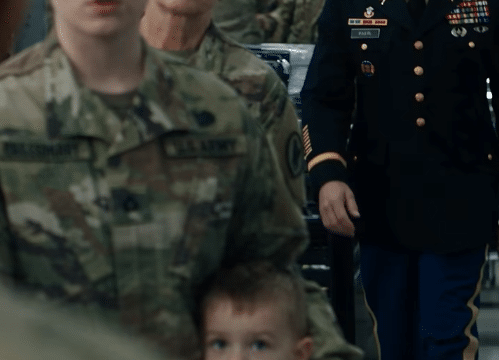
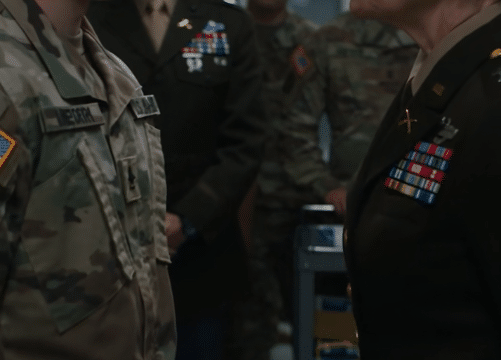
Only his decorated shoulders, impressive high-ranking insignia, dense ribbon rack, polished belt hardware, and immaculate military trousers were visible.
The authority was unmistakable.
He was a senior general whose rank stood considerably above Caldwell’s.
The six officers accompanying him moved with urgency, their attention fixed on the disturbance near the priority entrance.
Caldwell turned toward the approaching group.
At first, he looked irritated.
Then he noticed the senior officer’s insignia.
His expression changed.
He immediately straightened his back and adjusted the front of his uniform.
The event coordinator, who had been standing near the stage, recognized the arriving party and stepped aside.
But the senior general didn’t head toward the stage.
He didn’t stop to greet the organizers.
He didn’t even look at the ceremonial decorations.
He walked directly toward the fallen elderly man.
Caldwell watched in confusion.
Why would an officer of that stature ignore the entire command section to approach an injured civilian?
One of the accompanying officers moved forward, preparing to assist Arthur.
Another looked toward the crowd, noticing the people holding up their phones.
The senior general stopped.
His decorated shoulders faced Caldwell.
For a moment, he said nothing.
Then he looked down at Arthur’s injured face and the way the older man’s right sleeve rested against the floor.
His posture stiffened.
The officer’s attention moved slowly toward Caldwell.
The Brigadier General suddenly seemed much smaller than he had moments earlier.
He glanced at the senior general’s insignia again.
Then he looked at Arthur.
A strange uncertainty crossed his face.
He had seen the old man’s name on the guest list.
He had ignored the invitation.
He had dismissed his appearance.
And he had physically attacked him.
But there was something about the senior general’s reaction that suggested this was no ordinary mistake.
Then the question came.
Act IV
“Who put him on that floor?”
The senior general’s voice was calm, but the entire hall seemed to stop breathing.
Caldwell froze.
He looked at the decorated shoulders in front of him, then at the elderly man lying on the polished floor.
For several seconds, he appeared unable to understand what he was seeing.
One of the accompanying officers moved beside Arthur, carefully helping him remain comfortable.
The senior general did not take his eyes off Caldwell.
The Brigadier General tried to recover his composure.
His mouth opened, but no convincing explanation came.
Around them, the witnesses remained silent.
The woman who had screamed was still standing beside the registration counter. A veteran wearing an adaptive prosthetic device stared at Caldwell in disbelief.
A young soldier had his phone raised, recording everything.
There was no way to pretend the assault had never happened.
Arthur slowly lifted his head.
His cheek was visibly swollen, and his breathing remained uncomfortable. Yet he continued to look at the approaching officers with remarkable composure.
Then the truth began to register.
Arthur Bennett wasn’t simply a retired soldier.
He was a retired Four-Star General.
A former senior commander whose career had earned him the respect of generations of military personnel.
The empty right sleeve that Caldwell had treated as a reason to humiliate him represented a sacrifice made during a lifetime of service.
The old man had not come to the expo to demand recognition.
He had come because he wanted to support wounded veterans who were still struggling to find their place in civilian life.
He had deliberately avoided wearing his old decorations.
He had not introduced himself with his former rank.
He had simply wanted to attend an event celebrating people who understood sacrifice better than anyone.
And Caldwell had judged him by the one thing that mattered least: his appearance.
The Brigadier General’s eyes moved toward Arthur’s face.
Then toward the senior general’s higher insignia.
His confidence began to collapse.
The man he had punched was not someone who needed to prove his importance.
His record already spoke for itself.
And the senior general standing before Caldwell was not going to allow the incident to disappear behind a convenient explanation.
The witnesses had seen everything.
The recordings existed.
And the officer who had abused his authority was now standing directly in front of the consequences.
Act V
The hall remained silent.
The senior general stood beside Arthur while the accompanying officers arranged assistance for the injured veteran.
A member of the event staff hurried toward them, visibly shaken. The charity organizers were beginning to understand that their most distinguished guest had been assaulted at the very entrance meant to welcome him.
Caldwell stood motionless.
His one-star insignia remained visible on his uniform.
But it no longer seemed to give him the confidence it had provided only moments earlier.
He looked toward Arthur.
The elderly veteran didn’t glare at him.
He didn’t make threats.
He didn’t demand that anyone remove Caldwell’s uniform.
He simply watched him with an expression of cold dignity.
That was the part Caldwell couldn’t understand.
He had expected anger.
He had expected shouting.
He had expected the old man to beg for help or insist that he deserved respect.
Instead, Arthur had remained composed throughout the entire confrontation.
The senior general turned slightly toward the other officers.
The incident would be formally documented. The witnesses would be identified, the recordings preserved, and the appropriate military authorities notified.
Caldwell’s conduct would face an official investigation.
His position, his command responsibilities, and his future in uniform could no longer be protected by his rank alone.
The Brigadier General looked at the six officers surrounding the senior commander.
Then he looked at Arthur again.
The realization was almost unbearable.
The man he had considered unworthy of standing in the priority line had once occupied a position far above his own.
The man whose disability he had silently judged had spent a lifetime serving the institution Caldwell claimed to represent.
And the man he had thrown to the floor was the very kind of veteran the entire charity event was supposed to honor.
Caldwell’s face turned pale.
Sweat appeared along his forehead.
His jaw loosened as he struggled to process the impossible reversal.
Finally, he looked toward the senior general.
Then his eyes returned to Arthur.
“Sir… him?”
The words came out as a broken whisper.
The camera held on his terrified expression before cutting to black.
Arthur Bennett had never needed four stars on his shoulders to know who he was.
Caldwell, on the other hand, had needed a uniform, a title, and an audience to feel important.
And in front of hundreds of people gathered to celebrate wounded veterans, he had exposed the difference between wearing a uniform and deserving the respect it represented.
Tighten the Story’s Repeated ExpositionClarify the Senior General’s Identity Reveal