Act I
“Watch yourself.”
The sharp command cut through the noise of the crowded train platform.
A silver-haired man in a charcoal raincoat stood near the yellow safety line, one hand gripping his walking cane. His dark trousers were slightly damp from the rain, and beneath the fabric of his left trouser leg was a prosthetic limb.
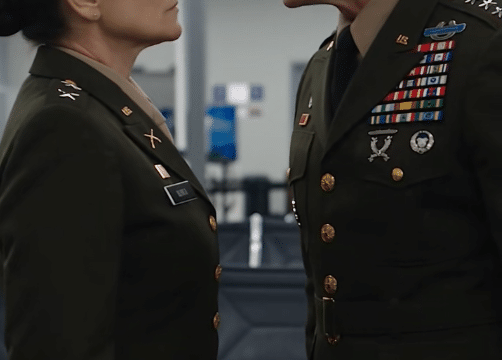
Standing directly in front of him was a uniformed U.S. Army Colonel.
At forty-eight, the officer carried himself like a man accustomed to being obeyed. His polished black shoes, regulation military overcoat, and silver eagle insignia made his rank unmistakable. He looked at the older man with open irritation, as though sharing the same platform was already an inconvenience.
The elderly man glanced down at the wet concrete.
“The platform’s wet.”
It was a simple explanation. No argument. No disrespect. Just a statement of fact.
But the Colonel’s expression hardened.
“Excuses don’t make you less careless.”
Several passengers turned toward them. A young woman standing beneath the station awning lowered her phone. An older commuter stopped adjusting his luggage.
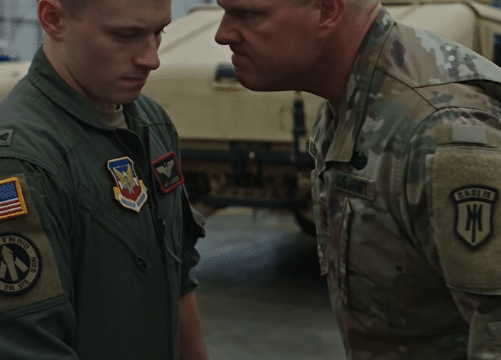
The Colonel stepped closer.
The retired soldier didn’t move.
He had spent enough years around military officers to recognize the difference between authority and arrogance. And this man, despite the eagles on his shoulders, seemed to understand very little about either.
Then the Colonel did something that would change his career forever.
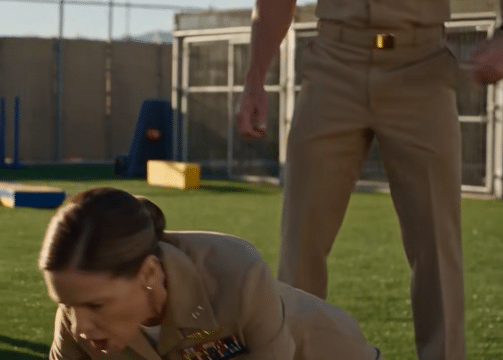
He swung his fist.
The punch struck the elderly man’s cheek with brutal force. His head snapped sideways, and a faint trace of blood appeared at the corner of his mouth.
Before anyone could react, the Colonel drove his boot into the man’s left prosthetic leg.
The artificial limb slipped against the rain-slick concrete.
The older man lost his balance and crashed onto the platform.
A suitcase rolled away. Someone gasped. A woman covered her mouth.
Yet the Colonel simply stood over him, looking down with contempt.
The elderly man struggled to steady his breathing. His cheek was swelling, but his eyes remained fixed on the officer.
He didn’t beg.
He didn’t apologize.
And he certainly didn’t look afraid.
The Colonel mistook that silence for weakness.
He had no idea who he had just attacked.
And he had even less idea who was about to arrive.
Act II
For the passengers watching, it was difficult to understand what they had just witnessed.
An American military officer had punched an elderly civilian and kicked his prosthetic leg. Not during combat. Not in an emergency. Not while defending anyone.
On an ordinary commuter platform.
The Colonel adjusted his overcoat, making sure his uniform remained neat. His silver eagle insignia caught the gray daylight as he looked down at the fallen man.
“Excuses don’t make you less careless.”
The words landed almost as cruelly as the punch.
The elderly man slowly shifted his weight, trying to protect his injured left side. His breathing was uneven, and pain crossed his face, but he maintained a controlled expression.
He had learned long ago that pain was not something a person needed to perform for an audience.
His name was Thomas Whitaker.
At least, that was the name most civilians knew.
For more than thirty years, Thomas had served in the United States Army. He had commanded soldiers in difficult circumstances, made decisions that affected thousands of lives, and watched young men and women leave home believing they would return unchanged.
They rarely did.
His military career had ended years earlier, but the Army had never entirely left him.
He still woke before sunrise. He still folded his clothes with almost obsessive precision. He still remembered the names of soldiers he had buried and the faces of those he had sent home.
His left leg had been lost during an overseas deployment. The details were rarely discussed, even with people close to him.
For Thomas, the prosthetic was not a symbol of tragedy.
It was simply part of the life he had fought to continue living.
After retirement, he had deliberately stepped away from military ceremonies and official attention. He preferred quiet train journeys, neighborhood coffee shops, and afternoons spent repairing old furniture in his garage.
He never introduced himself with his former title.
He didn’t need to.
But the Colonel knew none of this.
To him, Thomas was just an old man in an inexpensive raincoat who had somehow inconvenienced an officer wearing a prestigious uniform.
Around them, the witnesses remained frozen.
One passenger had already begun recording. Another moved closer, clearly considering whether to help the fallen man.
But Thomas raised one hand slightly, signaling that he was conscious and did not need anyone to panic.
His eyes returned to the Colonel.
There was something deeply unsettling about that look.
It wasn’t hatred.
It was disappointment.
And somewhere beyond the station entrance, several black command vehicles were approaching.
The Colonel still believed he was the most important man on that platform.
He was about to discover how wrong he was.
Act III
The first indication that something unusual was happening came from the sound of braking vehicles.
A black military command vehicle stopped near the station entrance.
Then another followed.
Passengers turned toward the road. A station employee stepped out from beneath the awning, confused by the sudden arrival.
The Colonel frowned.
He recognized the vehicles immediately.
They were not ordinary transportation. Their arrival suggested an official military movement, and the people who traveled in them were not accustomed to waiting for permission.
Five uniformed officers emerged and quickly formed around a senior military figure.
The senior officer’s face remained hidden from view. The camera caught only decorated shoulders, high-ranking insignia, rows of ribbons and medals, immaculate trousers, and polished military boots.
There was no need to see his face to understand his authority.
He outranked the Colonel by a considerable margin.
The officers accompanying him moved with disciplined urgency. Their attention was fixed on the far end of the platform.
On Thomas.
The Colonel’s expression changed.
At first, he looked irritated by the interruption. Then he noticed the senior officer’s decorations.
His shoulders stiffened.
He instinctively straightened his uniform.
The senior officer continued forward, his entourage following closely behind. No one spoke. Even the passengers seemed to understand that something significant was unfolding.
Thomas remained seated on the wet concrete.
He recognized the approaching figure, but showed no surprise. There was only a faint change in his expression, the kind that appears when someone sees a familiar face after a long absence.
The Colonel glanced between them.
He began to wonder whether the older man had some connection to the military.
Perhaps a relative.
Perhaps a former soldier.
But surely nothing that could justify the attention of someone carrying that many decorations.
Then the senior officer stopped directly beside him.
He didn’t look at the Colonel first.
He looked down at Thomas’s injured face.
Then his attention moved to the prosthetic leg lying awkwardly beneath the older man’s rain-soaked trousers.
His posture became rigid.
For a moment, nobody moved.
The Colonel swallowed.
He had seen that expression before on senior commanders. It was the expression of someone who had discovered something deeply wrong.
And then came the question that would destroy every excuse the Colonel had prepared.
Act IV
“Which leg did you kick?”
The senior officer’s voice was controlled.
But there was something beneath that control that made the entire platform feel colder.
The Colonel stared at him.
He looked down at the prosthetic leg, then back at the decorated shoulders standing before him.
His mouth opened slightly.
No answer came.
The senior officer had not raised his voice. He had not threatened him. He hadn’t even mentioned the Colonel’s name.
He didn’t need to.
The five officers behind him stood in absolute silence.
One of them moved toward Thomas, offering assistance. Another looked toward the passengers who had witnessed the assault.
The Colonel’s eyes shifted toward the senior officer’s insignia.
Then, slowly, he looked back at the old man on the ground.
Something was beginning to make sense.
Thomas Whitaker was not simply a retired serviceman who happened to be familiar with military life.
He was a retired Major General.
A man whose career had included command responsibilities far beyond anything the Colonel had ever held.
A man whose decisions had shaped the careers of officers who now wore stars of their own.
And the senior general standing over him was not an ordinary visitor.
He was a former colleague and longtime military friend who had arrived expecting to meet Thomas for a scheduled reunion.
Instead, he had found him injured on a wet platform, surrounded by frightened commuters.
The Colonel’s face began losing its color.
He glanced at the older man’s charcoal raincoat. At the silver hair. At the prosthetic leg.
Suddenly, the details he had dismissed as signs of weakness looked entirely different.
The prosthetic was not evidence of helplessness.
It was evidence of sacrifice.
The civilian clothes did not mean Thomas lacked a military history.
They meant he had chosen not to wear his old rank like a crown.
And the quiet man he had struck was someone whose service deserved more respect than the Colonel had shown in his entire encounter.
The Colonel’s hand trembled.
He tried to stand straighter, but his posture had already betrayed him.
The senior officer remained beside Thomas.
One of the accompanying officers began checking on the injured veteran. Another turned toward the witnesses, whose phones had captured the entire confrontation.
There would be no convenient misunderstanding.
No private version of events.
No claim that the old man had attacked first.
The evidence was already in the hands of the people who had seen everything.
The Colonel looked at Thomas again.
For the first time, he seemed to understand that the man he had knocked to the ground was not the one who should be explaining himself.
He was.
And the consequences were only beginning.
Act V
The platform had become completely silent.
Rainwater dripped from the edge of the station awning. Somewhere in the distance, a train approached, but nobody seemed interested in boarding it.
The senior general stood beside Thomas as the officers helped him into a more comfortable position.
Thomas winced slightly as he adjusted his injured leg.
The general’s attention never left him.
The Colonel stood a few feet away, his silver eagle insignia still visible on his uniform.
Only minutes earlier, those insignia had been his source of confidence.
Now they seemed almost unbearable.
He looked at the senior general’s decorated shoulders, then at Thomas.
His breathing became shallow. Sweat appeared along his forehead despite the cold rain.
He wanted to speak.
He wanted to explain that it had been an accident, that the platform was crowded, that the old man had been careless.
But the passengers had witnessed the punch.
They had watched the kick.
They had seen Thomas fall.
And they had heard the Colonel humiliate him while he was lying helpless on the wet concrete.
There was no explanation that could erase those moments.
Thomas finally raised his eyes toward the officer who had assaulted him.
He didn’t smile.
He didn’t threaten revenge.
He simply looked at him with the same quiet disappointment he had shown from the beginning.
That was somehow worse.
The senior general turned slightly toward his accompanying officers. His expression remained composed, but his message was unmistakable.
The incident would be documented. Witness statements would be preserved. The available recordings would be secured, and the appropriate military authorities would be notified.
The Colonel’s career, his conduct, and his future in uniform would now face serious scrutiny.
For a man who had spent years believing rank placed him above ordinary people, the sudden loss of control was almost impossible to process.
He looked at Thomas one last time.
Then his eyes returned to the senior general.
His face was pale.
His jaw loosened.
And the only word he could manage was the one he should have remembered before raising his fist.
“Sir…?”
The camera held on his terrified expression.
Then the screen cut to black.
Because the greatest mistake that Colonel had made wasn’t attacking an elderly man.
It was believing that a uniform gave him the right to humiliate someone who had sacrificed far more for that uniform than he ever would.
And on that rain-soaked platform, five senior officers and a crowd of silent witnesses were about to make sure he never forgot it.
Tighten the repeated expositionClarify Thomas’s hidden identity earlier