Act I
“Watch where you push that thing.”
The sharp voice came from a military officer standing beside a food truck at the base’s annual Family Day celebration.
An elderly man in a light-gray polo and navy windbreaker had just pushed a stroller past him. The stroller’s wheel had barely brushed the officer’s polished shoe.
The older man stopped and looked at him.
“It barely touched you.”
The officer’s expression hardened.
He was Brigadier General Richard Walker, a fifty-year-old commander accustomed to having people move out of his way before he even asked.
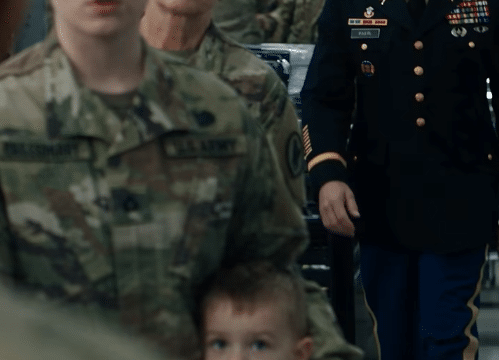
Beside him stood his young son, holding a drink and watching the confrontation with an amused expression.
The grandfather didn’t recognize the significance of the officer’s rank. He was more concerned about the small child sitting inside the stroller.
But Walker wasn’t interested in letting the incident go.
He stepped forward and kicked the front of the stroller.
It rolled several feet across the grass.
The grandfather immediately lunged forward, caught the handle, and secured the child before the stroller could tip.
He turned around.
That was when Walker struck him.
A powerful punch landed across the older man’s cheek. His face snapped sideways, and he staggered backward.
Before he could recover, the General drove a kick into his stomach.
The grandfather folded forward, struggling for breath.
Walker then shoved him backward onto the grass. The older man’s palm scraped against the ground as he fell.
Several families froze.
Children stopped playing.
A woman near the food trucks gasped.
The grandfather slowly raised his head, checking the stroller first.
The child was safe.
Only then did he look at the man standing over him.
Walker sneered.
“You’re an old nobody. You don’t touch my son.”
The grandfather said nothing.
He wiped the faint trace of blood from the corner of his mouth and slowly pushed himself upright.
Walker expected an apology.
Instead, the old man reached for his phone.
And made a call that would change the entire afternoon.
Act II
The grandfather’s name was Robert Mitchell.
At sixty-nine, he had learned that life was too short to spend it arguing with people who confused authority with importance.
He wore no military decorations.
His navy windbreaker carried no logos.
His khaki trousers and worn leather sneakers made him look like an ordinary grandfather enjoying an afternoon with his family.
But Robert had once worn the uniform of a Lieutenant General.
He had spent decades serving the United States military before retiring, earning the respect of countless soldiers and commanders along the way.
He rarely discussed his career.
Even his grandchildren knew very little about the details.
To them, he was simply Grandpa Robert, the man who brought snacks, told stories, and never missed an opportunity to take them somewhere interesting.
That afternoon, he had brought his youngest grandchild to the base’s Family Day celebration.
There were food trucks, military vehicle displays, children’s activities, and unit booths spread across a large open field.
It was supposed to be a happy afternoon.
Robert had been pushing the stroller toward a shaded seating area when the wheel brushed Walker’s shoe.
It was an insignificant accident.
But Walker’s reaction revealed something much bigger.
He was accustomed to people treating his rank as permission to behave however he pleased.
His son had grown up watching that attitude.
Whenever someone challenged him, his father intervened.
Whenever someone complained, his father’s position made the problem disappear.
The young man had learned that connections mattered more than consideration.
Now, watching his father intimidate an elderly grandfather, he initially seemed entertained.
But the atmosphere around them was changing.
Families were staring.
Several military spouses had taken a step backward.
An instructor standing beside a display vehicle had stopped talking.
Robert, meanwhile, wasn’t looking at any of them.
He was checking that the child remained comfortable.
Then he looked at his phone.
The call was already connecting.
And when he finally spoke, he gave only three pieces of information.
Act III
“Family field. North entrance. Five minutes.”
Robert ended the call.
Walker watched him with an amused expression.
He had no idea who the old man had contacted.
He assumed it was a family member, perhaps someone who could come and collect him.
The General folded his arms.
“Call whoever you want. My rank ends this.”
Robert didn’t respond.
He simply put his phone away.
His cheek was swelling, his breathing was still uncomfortable, and one palm was scraped from the fall.
Yet his expression remained calm.
Walker interpreted that calmness as surrender.
He turned toward the nearby families as if expecting everyone to understand that the confrontation was over.
But nobody seemed convinced.
A mother pulled her child closer.
A military spouse whispered something to her husband.
A young soldier standing near the activity booths looked toward the stroller, then at Robert’s injured face.
The General’s son began to lose his confidence.
He had expected his father to scare the old man into leaving.
Instead, the grandfather appeared to be waiting for something.
Five minutes.
That was all he had said.
Walker glanced toward the north entrance.
At first, there was nothing unusual.
Then several black military vehicles appeared beyond the field.
They moved in formation, followed by another vehicle carrying members of a senior command detail.
Conversations began fading across the family area.
The convoy entered the field.
The center vehicle stopped.
Its door opened.
A senior military figure stepped out.
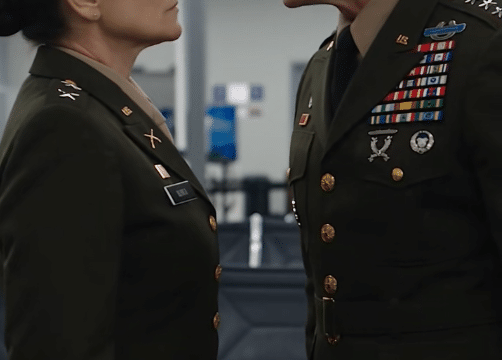
The camera caught only polished ceremonial boots, a decorated uniform, broad shoulders, and an unmistakable four-star insignia.
The face remained hidden.
The figure began walking directly toward Robert and the stroller.
Walker stopped smiling.
Something about the arrival was familiar.
But he hadn’t yet connected the pieces.
Act IV
The senior figure continued across the field.
The crowd gradually moved aside.
Military personnel straightened as the decorated uniform approached.
Robert remained beside the stroller.
He didn’t wave.
He didn’t call out.
He simply watched the approaching figure with the quiet expression of someone who had been expecting him.
Walker looked at the four-star insignia.
Then he looked at Robert.
Then back toward the approaching commander.
A terrible realization began forming.
The elderly man had not called someone to complain.
He had called someone who mattered.
Someone who had responded personally.
Someone whose arrival could not be dismissed with a display of rank.
Walker tried to understand the relationship.
The older man’s ordinary clothing suddenly seemed irrelevant.
The worn sneakers.
The simple windbreaker.
The lack of decorations.
None of it changed who he was.
And the approaching figure’s direction made the situation even more uncomfortable.
He wasn’t walking toward Walker.
He was walking toward Robert and the stroller.
The General’s jaw tightened.
His son had stopped smiling completely.
The surrounding families watched in silence as the four-star commander crossed the remaining distance.
Then Walker remembered something.
The base’s senior commander had a family connection to the installation’s retired leadership.
There had been photographs in command offices.
There had been stories about a legendary former Lieutenant General whose career had influenced generations of officers.
Walker had never imagined that the quiet grandfather standing in front of him could be connected to that history.
But the pieces were finally coming together.
And the realization was far worse than anything he had expected.
Act V
Walker stared at the approaching four-star figure.
The decorated shoulders.
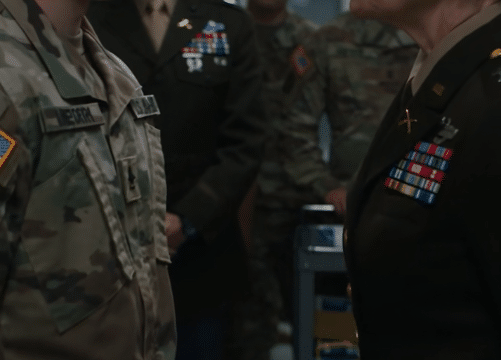
The dense ribbon rack.
The ceremonial uniform.
Every detail confirmed that this was no ordinary arrival.
The senior commander continued directly toward the stroller.
Robert stood beside it, one hand resting gently on the handle.
His expression had not changed.
He hadn’t needed to explain his identity to the crowd.
He hadn’t needed to demand that Walker apologize.
The approaching officer already knew exactly who he was.
And the relationship between them was becoming painfully clear.
The retired Lieutenant General in the navy windbreaker was not merely an old family friend.
He was the commander’s father.
The man who had helped shape his life long before he ever earned his fourth star.
Walker looked at Robert again.
The man he had punched.
The grandfather whose stroller he had kicked.
The retired officer he had called an old nobody.
His face drained of color.
For the first time, his rank offered no comfort.
His son stood frozen behind him.
The surrounding families remained silent.
And Walker finally understood that the man he had treated as insignificant was the father of the most powerful officer on that installation.
His lips parted.
“That’s his father…?”
The question came out almost as a whisper.
But there was no answer.
The camera held on the General’s terrified expression before cutting to black.
Robert had never needed to tell anyone who he was.
He had simply wanted to spend an afternoon with his grandchild.
And the man who had mistaken his humility for weakness had just discovered the difference between a person’s appearance and the life they had lived.
Because real authority doesn’t announce itself through arrogance. Sometimes, it arrives quietly, wearing an ordinary windbreaker and pushing a stroller.