Act I
The ticket was lying in the dirt when the first kick landed.
Nobody at the county fair understood what they were witnessing at first. One moment, an elderly man in a faded denim jacket was trying to retrieve a dropped admission ticket. The next, a decorated two-star general in a perfectly pressed U.S. Army uniform was standing behind him, preparing to teach him a lesson he would never forget.
“Move.”
The command came with the unmistakable arrogance of someone accustomed to being obeyed.
The older man slowly turned his head. His silver hair caught the warm glow of the carnival lights. His left sleeve was neatly folded above the elbow, revealing that his arm had been amputated years earlier. Despite his age and disability, there was something remarkably steady about his expression.
“It’s one ticket,” he replied.
The general glanced down at the small piece of paper.
He could have stepped around the man. He could have waited two seconds. He could even have picked up the ticket himself.
Instead, he watched the old man bend forward.
And then he kicked him.
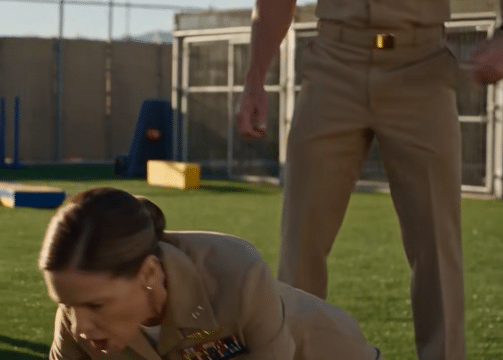
The impact drove the elderly veteran forward. His hands struck the dirt walkway, and his knees followed. Families standing near the entrance froze. A little girl stopped holding her father’s hand. A woman carrying a tray of food gasped as the old man struggled to catch his breath.
But the uniformed officer wasn’t finished.
As the veteran tried to push himself upright, the general delivered three more kicks into his hip and rib area.
The old man curled instinctively from the pain.
He didn’t scream.
He didn’t beg.
He simply fought to breathe.
The general stood over him, adjusting his posture as though he had just dealt with an inconvenience.
“Then pick it up faster.”
A terrible silence spread through the entrance.
Several people looked at the general’s two-star insignia. Others stared at the elderly man lying in the dirt.
Nobody seemed able to understand how a senior military officer could behave this way in front of ordinary American families.
But the general had made one enormous mistake.
He had judged the man on the ground by his missing arm, his old clothes, and his apparent lack of power.
He had no idea whose dignity he had just attacked.
And before anyone could intervene, the sound of approaching military vehicles changed everything.
Act II
The elderly man’s name was Thomas Whitaker.
He was sixty-nine years old, a widower, and a retired Lieutenant General who had spent more than four decades serving the United States Army.
But none of that was visible in his appearance.
There were no medals pinned to his denim jacket. No military decorations hanging from his chest. No official vehicle waiting nearby. He had deliberately chosen to attend the county fair dressed like an ordinary grandfather.
For Thomas, the fair was a place where people could forget about ranks, orders, and political arguments.
It reminded him of the summers he had spent with his late wife, Margaret, and their daughter, Emily.
Years earlier, Margaret had loved county fairs. She loved the smell of freshly cooked food, the ridiculous carnival games, and the sound of children laughing beneath strings of colored lights.
After she passed away, Thomas had continued visiting places like this.
It was his quiet way of keeping a promise.
That afternoon, he had arrived early because he wanted to watch the military appreciation ceremony scheduled for later that evening.
He had no intention of making an appearance.
In fact, very few people in the county knew about his military history.
The loss of his left arm had happened decades earlier during a deployment. He had spent months recovering, learning to adapt, and eventually returning to command.
He had never considered the injury a reason to surrender his life.
He had learned something else during those difficult months, too.
A person’s character was never measured by how loudly he could command others. It was measured by how he treated people who could do absolutely nothing for him.
That belief had shaped his entire career.
And it was exactly why he had refused to respond when the younger general first confronted him.
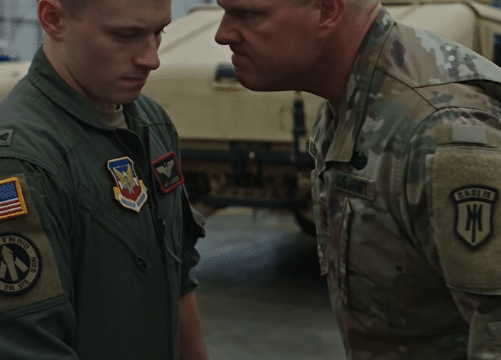
The man attacking him was Major General Richard Caldwell, a fifty-year-old officer attending the fair as part of its official military appreciation program.
Caldwell was accustomed to being the most important person in every room.
He expected staff members to anticipate his needs, civilians to move out of his way, and junior officers to respond before he finished speaking.
His two stars had become more than a military rank.
They had become his personality.
That afternoon, he had been running late for the ceremony. The entrance was crowded, his security detail was nowhere immediately visible, and the elderly man standing near the ticket booth had become an obstacle in his path.
Caldwell had decided that the old man needed to learn respect.
What he failed to recognize was that Thomas Whitaker had spent a lifetime commanding men who understood the difference between respect and fear.
And the people watching the assault were beginning to realize that something far more serious had happened than a simple argument over a ticket.
One witness had already reached for his phone.
Then, from beyond the fairground entrance, came a sound that made everyone turn.
Act III
At first, it sounded like ordinary traffic.
Then came the synchronized movement of military vehicles approaching the fairground.
A dark official convoy entered through the main access road. Its arrival was unmistakably coordinated. Several people stepped aside as the vehicles slowed near the entrance.
Caldwell straightened his uniform.
For a moment, he seemed relieved.
Perhaps this was the security team he had been expecting. Perhaps someone had finally arrived to restore order and remove the crowd gathering around him.
But then the doors opened.
Four military officers stepped out, followed by a Command Sergeant Major.
They didn’t look toward the ticket booth.
They didn’t look at the families.
Their attention was fixed on the elderly man lying in the dirt.
And then the final figure emerged.
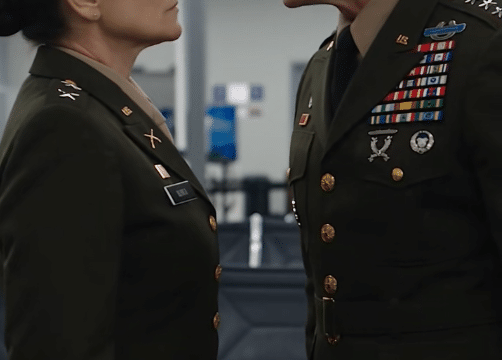
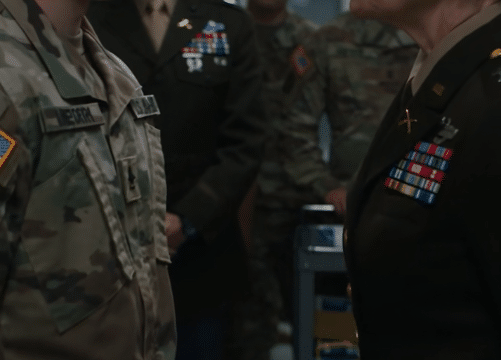
He wore a highly decorated senior command uniform, with rank insignia and ribbons that immediately distinguished him from everyone else present.
His face remained out of view as the camera followed his polished boots moving rapidly across the walkway.
The officers accompanying him moved with unmistakable purpose.
Caldwell’s expression changed.
He recognized the significance of the uniform.
This wasn’t an ordinary official visit. This was someone whose authority stood far above his own.
The senior figure stopped beside Thomas.
One of the accompanying officers immediately moved toward the injured veteran, while the Command Sergeant Major stood nearby, his expression rigid.
Thomas slowly lifted his eyes.
For the first time since the assault, a faint recognition crossed his face.
He knew that voice.
He knew those boots.
And he knew that the person standing beside him would never have come to the county fair without a very important reason.
The senior figure didn’t offer an explanation.
He didn’t introduce himself.
He simply looked down at the dirt, then at the injured man’s folded left sleeve.
His attention shifted toward the general standing several feet away.
The crowd seemed to stop breathing.
Caldwell tried to maintain his military bearing, but his eyes kept moving between the approaching officers and the man he had just kicked.
Something wasn’t adding up.
Why had an entire senior command entourage rushed toward an elderly civilian?
Why had the Command Sergeant Major positioned himself protectively beside him?
And why was the most senior person in the group looking at Caldwell as though he had committed an unforgivable offense?
Then came the question.
“Which boot did that?”
Act IV
The words were quiet.
That made them even more frightening.
The senior commander didn’t shout. He didn’t need to.
His question hung over the entrance like a formal accusation.
Caldwell looked down at his polished black military shoes.
Then he looked back at the elderly man.
For the first time, his confidence began to fracture.
He had spent years believing that rank could protect him from consequences. He had assumed that civilians would never challenge him and that other officers would instinctively defend someone wearing two stars.
But nobody moved to defend him.
The four officers remained silent.
The Command Sergeant Major didn’t even look in his direction.
Instead, their attention stayed with Thomas.
One officer crouched beside the retired general, carefully checking his condition. Another moved to create space around him while the surrounding witnesses watched in disbelief.
Thomas slowly shifted onto one knee.
His breathing was still uneven. His side hurt, and his right palm was scraped from the fall.
Yet he refused to turn the moment into a spectacle.
He didn’t point at Caldwell.
He didn’t demand an apology.
He simply looked at the senior commander with the same calm expression he had maintained before the first kick.
That composure seemed to make Caldwell even more uncomfortable.
The active-duty general finally noticed what he should have noticed from the beginning.
The senior commander’s entourage was not treating Thomas like an ordinary civilian.
They were treating him like someone whose service, sacrifice, and authority deserved the deepest respect.
Caldwell’s eyes returned to the folded sleeve.
Then to the older man’s face.
He began to understand that the missing arm wasn’t evidence of weakness.
It was evidence of a history he knew nothing about.
The old man had not been wearing a uniform because he no longer needed one to prove who he was.
And suddenly, Caldwell’s two stars seemed very small.
Sweat appeared along his forehead.
His jaw loosened. His shoulders dropped. The rigid posture he had displayed moments earlier began to collapse.
Around him, the witnesses remained completely silent.
The woman holding the food tray was still standing where she had been when the first kick landed. A father had moved his daughter behind him. A young man who had recorded part of the assault lowered his phone slightly, unable to believe what he was seeing.
Caldwell finally opened his mouth.
But he couldn’t find a sentence that would save him.
Because the truth was becoming impossible to escape.
He had assaulted a retired Lieutenant General in front of an entire crowd.
And the senior commander who had just arrived clearly knew exactly who Thomas Whitaker was.
Yet the most terrifying part was still the question Caldwell couldn’t bring himself to ask.
What was the relationship between these two men?
And what would happen when the truth became official?
Act V
For a few seconds, nobody spoke.
The senior commander remained beside Thomas, his face hidden from view. The officers formed a protective space around the injured veteran, while the Command Sergeant Major stood between him and the man responsible.
Thomas finally managed to stand with assistance.
His denim jacket was dusty. His breathing remained guarded. But he lifted his chin and looked directly at Caldwell.
There was no triumph in his expression.
No smile.
No satisfaction at seeing another man frightened.
Only disappointment.
That was somehow worse.
Caldwell had expected anger. He had expected threats, perhaps even an argument about rank.
He had not expected to face the quiet judgment of a man who had already sacrificed more for his country than Caldwell could ever understand.
The senior commander turned slightly toward the active-duty general.
His decorations caught the light from the carnival entrance.
Caldwell looked at those insignia, then at Thomas.
The realization finally reached his face.
The man he had kicked wasn’t simply an elderly veteran attending a county fair.
He was a retired Lieutenant General.
A man whose military career had been built long before Caldwell ever wore his first officer insignia.
And the people standing around him were not arriving to protect Caldwell.
They were arriving because Thomas mattered.
Because his service mattered.
Because what had just happened to him could not be dismissed as an argument over an admission ticket.
The general swallowed.
His eyes widened, and the last trace of arrogance disappeared.
He looked as though he wanted to apologize, explain himself, and somehow rewind the previous thirty seconds.
But there was no way to retrieve those moments.
The witnesses had seen everything.
The cameras had captured the assault.
And the senior commander’s presence meant that the incident would not simply disappear into a quiet conversation behind closed doors.
Caldwell stared at Thomas one more time.
His voice finally emerged, barely above a whisper.
“Sir… he is…?”
The sentence remained unfinished.
The camera held on his face.
His forehead was damp with sweat. His eyes were wide. His mouth remained slightly open, as though the final words had become impossible to say.
Then the screen cut to black.
Somewhere behind him, the carnival lights continued flashing.
Children still waited for rides. Food vendors still served their customers. The county fair carried on as though nothing had happened.
But for one two-star general, the world had just changed.
He had believed that power meant people had to move when he said, “Move.”
That afternoon, he discovered something far more important.
A uniform can give a man authority. It cannot give him honor.