Act I
“He shoved me and laughed when I told him who you were.”
The young man’s accusation cut through the elegant ballroom.
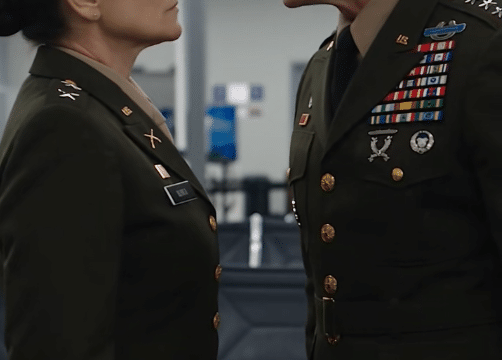
Standing beside him was his father, Brigadier General Richard Lawson, a decorated officer in full dress uniform. Across from them stood an older gentleman in a dark navy suit, his silver hair neatly combed and his expression remarkably calm.
The older man looked at the young civilian.
Then he turned toward the General.
“That never happened.”
But Lawson wasn’t interested in hearing his side.
His twenty-three-year-old son, Ethan, had always been protected by his father’s rank. He had grown accustomed to getting his way, and whenever someone challenged him, he knew exactly which name to invoke.
Tonight, he had chosen the wrong man to provoke.
Lawson’s face tightened.
He grabbed a glass of wine from the banquet table and threw its contents directly into the older man’s face.
Then he hurled the glass onto the ballroom floor.
It shattered.
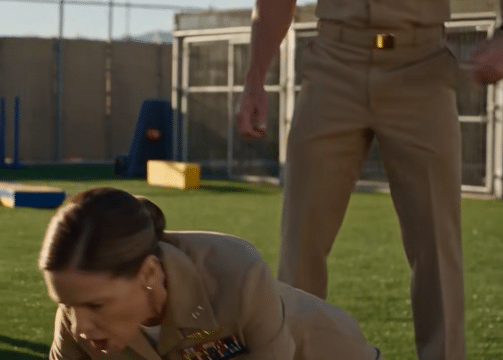
Before anyone could react, Lawson punched the older gentleman across the cheek. The man’s head snapped sideways, and a red mark immediately appeared across his face.
Then came a hard kick to the stomach.
The older man folded forward, struggling to catch his breath.
A second kick struck his ribs, sending him down beside the banquet table.
The ballroom fell silent.
Officers, spouses, retired servicemen, and decorated veterans stared in disbelief.
Lawson stood over the injured guest, his expression still filled with anger.
“Touch my family again and you’ll leave crawling.”
Ethan stood behind his father.
For a moment, he looked satisfied.
He believed his father had defended him.
He believed the older man had finally been taught a lesson.
But at one of the nearby tables, a retired Command Sergeant Major had just recognized the victim.
And the expression on the old soldier’s face was about to change everything.
Act II
The man on the floor was not someone who enjoyed attention.
His name was William Harrison.
At sixty-four, he had spent decades avoiding public recognition, even at events where people regularly introduced themselves through their military achievements.
He wore an ordinary navy suit, a white shirt, and a burgundy tie.
There were no medals on his chest.
No military insignia.
No entourage following him around the ballroom.
To someone unfamiliar with the regiment’s history, he looked like another retired officer attending an annual celebration.
But William Harrison had once been a Lieutenant General.
More importantly, he had been one of the central figures responsible for building the regiment into the institution it had become.
His influence had extended far beyond his own command.
He had helped establish its training standards, strengthened its leadership culture, and guided generations of officers who later became senior commanders themselves.
He had never demanded recognition for those contributions.
In fact, he had deliberately chosen to attend the banquet as an ordinary guest.
He wanted to reconnect with old friends, remember fallen comrades, and enjoy an evening without being surrounded by people treating his former rank as a reason to flatter him.
Unfortunately, Ethan Lawson had mistaken his quiet manner for weakness.
The young man had arrived at the banquet expecting special treatment.
His father was a Brigadier General, and Ethan had spent much of his adult life benefiting from that connection.
He rarely considered how his behavior affected other people.
Earlier that evening, he had pushed his way through a crowded reception area and accidentally knocked into William.
William had calmly asked him to be more careful.
Ethan had taken offense.
When William refused to apologize for something he hadn’t done, Ethan decided to turn a minor disagreement into a much bigger problem.
He found his father and invented a story.
He claimed William had shoved him and laughed after hearing whose son he was.
Lawson believed him immediately.
And now, in front of an entire ballroom, that blind loyalty had produced an act of violence that nobody could simply overlook.
But the first person to understand the full significance of what had happened was not the General.
It was a retired soldier sitting only a few tables away.
Act III
Retired Command Sergeant Major Thomas Reed had been watching the confrontation unfold.
At sixty-eight, Reed had served alongside some of the most respected officers in the regiment’s history.
He knew William Harrison.
Not merely by reputation.
He knew the man personally.
He remembered the early years when the regiment was struggling with outdated procedures and declining morale.
He remembered the long nights, difficult decisions, and difficult conversations that had shaped its future.
And he remembered the Lieutenant General who had never asked his soldiers to do something he wasn’t prepared to do himself.
That man was William Harrison.
Reed slowly pushed his chair backward.
His eyes remained fixed on the injured guest.
He recognized the silver hair.
The familiar face.
The unmistakable composure.
He stood.
The movement caught the attention of several nearby veterans.
Then Reed spoke.
“General… you just hit the man who built this regiment.”
Lawson turned toward him.
His expression showed irritation rather than concern.
He looked down at William, who was beginning to recover his breath beside the banquet table.
Then he dismissed the warning.
“He’s just an old guest.”
The words landed heavily.
Reed said nothing more.
But his expression made it clear that the General had just made another terrible mistake.
William slowly raised his head.
Despite the pain in his cheek and ribs, he remained composed.
He looked at Lawson.
Then he glanced toward the people sitting behind him.
There was no anger in his voice when he finally spoke.
“Then ask why everyone behind you just stood up.”
Lawson frowned.
He hadn’t noticed what was happening.
Not yet.
But Ethan had.
The young man’s smile had disappeared.
His eyes were fixed on the tables behind his father.
One retired officer was standing.
Then another.
And another.
The movement was spreading across the ballroom.
Something extraordinary was happening.
And it had absolutely nothing to do with the General’s rank.
Act IV
Lawson slowly turned around.
What he saw made him stop breathing for a moment.
Across the ballroom, retired senior officers and veterans were rising from their chairs.
Some were former colonels.
Others were retired generals.
Several were men who had served under William Harrison during the most important years of the regiment’s development.
They weren’t standing because someone had ordered them to.
Nobody had announced a ceremony.
There was no introduction, no presentation, and no official recognition.
They were standing because they knew exactly who was lying on the floor.
And they refused to remain seated while a man they respected was treated like an insignificant stranger.
One elderly veteran straightened his jacket.
Another quietly placed his glass on the table.
A former regimental commander stood with both hands resting on the back of his chair.
Nobody applauded.
Nobody shouted.
Their silence was more powerful than either.
Lawson looked from one table to another.
The faces were familiar.
These were men whose careers he had studied, officers whose achievements appeared in regimental records, and veterans whose service he had spent years trying to emulate.
Yet every one of them was standing for the same injured man.
Ethan began to step backward.
He finally understood that his father’s uniform could not protect him from what he had done.
He had lied about an old man.
His father had believed him without checking the facts.
And together, they had assaulted someone whose legacy was woven into the very identity of the regiment.
Lawson turned back toward William.
The older man was still beside the banquet table.
He wasn’t smiling.
He wasn’t celebrating.
He simply looked at the General with the same quiet expression he had worn throughout the confrontation.
That was what frightened Lawson most.
William didn’t need to threaten him.
He didn’t need to announce his former rank.
He didn’t even need to explain why the entire ballroom had risen.
The people behind Lawson had already answered that question.
The General’s face began to lose its color.
For the first time that evening, he realized that he had defended his son’s lie at the expense of something far greater than his own reputation.
He had disrespected an entire generation of soldiers.
And they were all watching him.
Act V
The ballroom remained completely still.
Ethan stood behind his father, no longer looking like the confident young man who had started the confrontation.
His eyes moved between the standing veterans and William Harrison.
He finally understood why the older gentleman hadn’t reacted to the insults.
William had spent his life earning respect.
He didn’t need to demand it from strangers.
Lawson slowly looked back toward the man he had attacked.
The General’s expression had changed completely.
His anger had disappeared.
His certainty was gone.
In its place was a growing realization that the people standing behind him knew William far better than he ever could.
These weren’t strangers impressed by a famous name.
They were men who had served with him, learned from him, and trusted him with their lives.
William had helped shape their regiment.
And they had never forgotten.
Lawson looked at Reed.
Then at the veterans.
Then back at the older man in the navy suit.
He seemed to be searching for some explanation that would make the moment less devastating.
But there was none.
His son’s lie had started the confrontation.
His own arrogance had turned it into an assault.
And his refusal to listen had made the entire regiment witness his failure of leadership.
His lips parted.
The words came out slowly, almost in disbelief.
“They all know you…?”
Nobody answered.
The veterans remained standing.
Ethan looked down.
And William Harrison, the man who had built the regiment but never demanded to be remembered for it, remained the quiet center of the room.
That evening, Lawson learned a lesson that no decoration on his uniform could teach him.
A father may defend his son out of love. But when he chooses a lie over the truth, he risks destroying everything his uniform is supposed to represent.
And sometimes, the most respected man in the room is the one who never needs to tell anyone who he is.