Act I
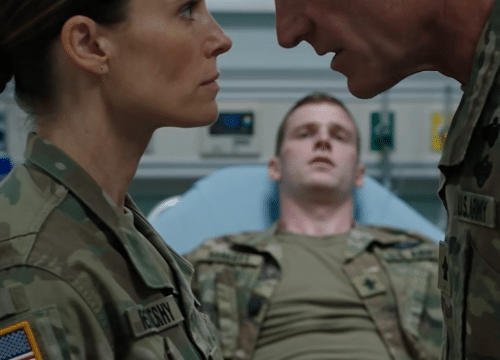
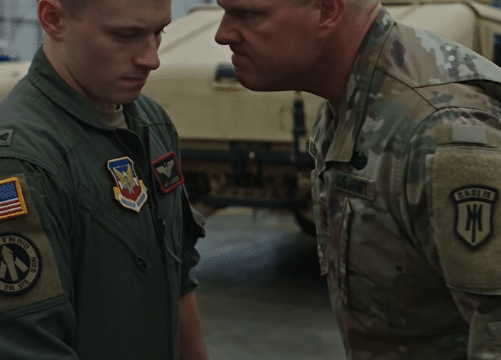
“Colonel, he called our whole security team incompetent.”
The Second Lieutenant delivered the accusation with just enough outrage to make it sound believable.
Standing beside him was a sixty-one-year-old civilian dressed in a brown sport coat, pale-blue shirt, and dark trousers. His short silver hair and calm expression gave no indication that he had ever worn a military uniform.
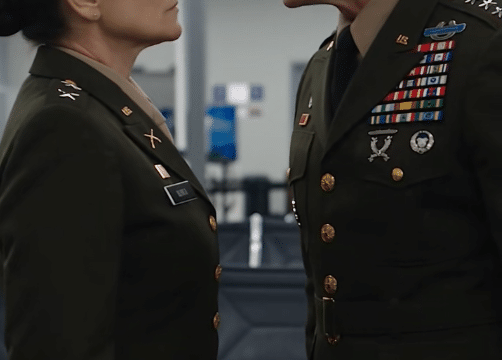
The Colonel overseeing gate security immediately turned toward him.
The older man looked directly at the young lieutenant.
“I said no such thing.”
But the Colonel had already made up his mind.
He saw an older civilian questioning his security personnel, a junior officer claiming disrespect, and an opportunity to demonstrate that nobody challenged his authority inside his gate.
Without asking a single follow-up question, he stepped forward.
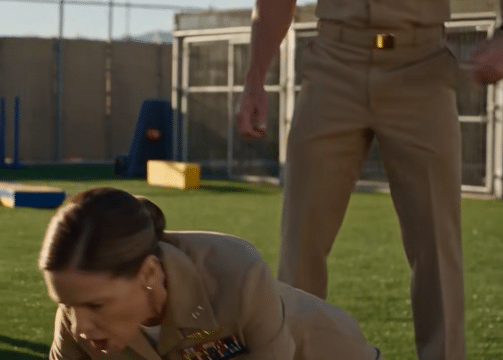
His fist struck the older man’s cheek.
The impact sent the man’s head sideways. Before he could recover, the Colonel drove a kick into his stomach, forcing him to fold forward and gasp for breath.
A second kick struck his ribs, sending him crashing beside the visitor center’s waiting chairs.
A woman waiting for an escort covered her mouth.
A security employee froze behind the registration desk.
The Second Lieutenant who had started the entire confrontation watched with growing uncertainty.
The Colonel straightened his uniform.
“You don’t insult soldiers inside my gate.”
The older man remained conscious, breathing carefully as he slowly lifted his head.
There was blood at the corner of his mouth, but his expression remained remarkably controlled.
He looked at the Colonel.
Then at the young lieutenant.
And he understood something neither man had considered.
The accusation had been a lie.
But the consequences were about to become very real.
Act II
The visitor center was supposed to be one of the most welcoming places on the base.
Civilians arrived there every day to register, meet military personnel, obtain visitor passes, and wait for authorized escorts.
The security team had an important responsibility.
They were the first representatives of the installation that most visitors encountered.
Unfortunately, Colonel Richard Hayes had developed a different understanding of that responsibility.
At forty-four, Hayes had become obsessed with maintaining an image of absolute authority.
He disliked questions.
He disliked being corrected.
And he particularly disliked civilians who refused to become intimidated by his uniform.
His reputation had grown around a simple philosophy: people behaved properly when they were afraid of the consequences.
Second Lieutenant Jason Cole had learned that philosophy quickly.
At twenty-four, Cole was inexperienced, ambitious, and desperate to impress his superiors.
He had recently been assigned to assist with visitor operations, where he was expected to learn how the installation handled access procedures and security complaints.
But Cole wanted something more immediate than experience.
He wanted recognition.
When the older visitor questioned an unnecessarily complicated registration procedure, Cole had taken it personally.
The man had not insulted anyone.
He had simply asked why he was being required to repeat information that had already been entered into the system.
Cole interpreted the question as a challenge.
Rather than admit that he did not know the answer, he approached Colonel Hayes with a fabricated complaint.
He claimed the visitor had called the entire security team incompetent.
Hayes didn’t ask for evidence.
He didn’t request an explanation from the visitor.
He simply reacted.
Now, as the older man struggled to sit upright beside the chairs, Cole began to realize the seriousness of what he had done.
The visitor wasn’t shouting.
He wasn’t threatening to sue anyone.
He wasn’t even demanding that the Colonel apologize.
That calmness made Cole increasingly uncomfortable.
He had expected anger.
He had expected a frightened civilian begging for help.
Instead, the man was looking at him with the quiet disappointment of someone who had seen this kind of dishonesty before.
And suddenly, Cole wondered whether the person he had lied about was someone he should never have approached in the first place.
Act III
Colonel Hayes glanced toward the registration desk.
Nobody had intervened.
That suited him.
He believed the incident had been handled, and he expected the older visitor to understand that challenging military security personnel came with consequences.
But the visitor slowly reached into his pocket and retrieved his phone.
His cheek was swollen.
His breathing remained guarded.
Yet his fingers moved without hesitation.
He made a brief call.
“Visitor Center. Main gate. Four minutes.”
He ended the call.
Hayes raised an eyebrow.
The older man placed the phone away and looked toward the glass entrance.
For a moment, nobody spoke.
Then the Colonel gave a dismissive laugh.
“Go ahead. Tell someone how badly you behaved.”
Cole shifted his weight.
Something about the call bothered him.
The visitor hadn’t asked for an ambulance through the security desk. He hadn’t requested a supervisor. He hadn’t even explained who he had contacted.
He had simply given a location and a time.
Four minutes.
Cole glanced through the glass.
Outside, the main gate remained busy with ordinary military traffic.
Then, in the distance, several black vehicles appeared.
They moved together with unmistakable coordination.
A command convoy.
The first vehicle slowed near the entrance.
The second followed.
The final vehicle stopped directly outside the visitor center.
Cole’s expression changed.
The Colonel noticed the movement but didn’t yet understand why the young lieutenant had suddenly gone quiet.
A vehicle door opened.
Polished black boots touched the pavement.
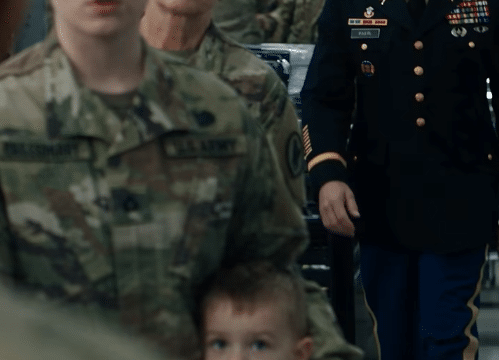
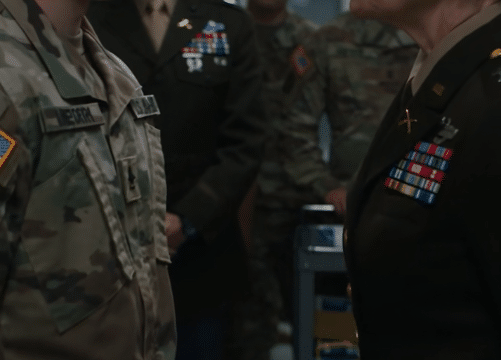
A decorated military uniform emerged from the vehicle, followed by shoulders bearing senior insignia and rows of ribbons.
The camera caught only fragments.
The boots.
The decorations.
The senior uniform.
Never the man’s face.
Cole stared through the glass.
Then the color drained from his face.
He recognized the general immediately.
And he understood why the older visitor had made that call.
Act IV
The entrance doors opened.
The senior officer walked into the visitor center.
His presence changed the atmosphere instantly.
Security personnel straightened.
The registration employees stopped what they were doing.
The civilians waiting for escorts turned toward the entrance.
But Cole was no longer looking at the general’s decorations.
He was looking at the older man beside the waiting chairs.
The connection was becoming painfully obvious.
The retired Major General had not come to the installation as an ordinary visitor.
He had arrived without a military escort, without a formal introduction, and without using his former rank to demand special treatment.
He had simply expected the same basic courtesy and professionalism that should have been extended to anyone entering the base.
And Cole had fabricated an insult to make himself look important.
Hayes finally noticed the Second Lieutenant’s expression.
He followed the young officer’s gaze toward the entrance.
Then he looked back at the injured civilian.
His confidence began to disappear.
The older man was still wearing his brown sport coat.
His uniform was nowhere to be seen.
There had been no obvious indication of his former position, no introduction, and no warning that he had once held one of the highest ranks in the military.
But the general entering the building clearly knew him.
Cole stood completely still.
He had wanted to impress a Colonel.
Instead, his lie had helped provoke a physical assault against a retired Major General.
And now a decorated general had arrived to find out what happened.
Hayes began to understand that the situation was far beyond an ordinary complaint.
The man he had struck had spent decades serving the very institution Hayes claimed to defend.
Worse, the lie that triggered the assault had come from one of his own junior officers.
There was no longer any way to make the incident look like a simple misunderstanding.
The Colonel looked from the senior officer to the injured visitor.
For the first time, he seemed genuinely afraid of what the next few seconds might reveal.
Act V
The visitor center had become completely silent.
Cole’s earlier confidence had vanished.
He couldn’t look at the older man for more than a second.
He knew what he had said.
He knew the accusation had been false.
And he knew that the Colonel had acted on his words without verifying a single detail.
But the worst part was still unfolding.
Hayes watched the decorated senior officer approach.
Then he looked toward the retired Major General.
Something about their familiarity finally registered.
The visitor hadn’t needed to announce his identity.
He hadn’t needed to display medals or explain his former command.
The general already knew exactly who he was.
And that recognition was enough to expose how badly Hayes had misjudged the situation.
The Colonel’s expression shifted from confusion to disbelief.
His mouth opened slightly.
He looked at the older man again, now seeing something entirely different from the civilian he had attacked just minutes earlier.
The man in the brown sport coat had not been trying to challenge his authority.
He had been showing the restraint of someone who understood that real authority did not need to be announced.
And Hayes had mistaken that restraint for weakness.
His eyes widened.
His voice dropped.
“He knows you…?”
The question hung in the air.
Cole stood pale behind him.
The civilians who had witnessed the assault remained frozen.
And somewhere between the main gate and the visitor center, the Colonel’s entire understanding of power had collapsed.
He had attacked a man because he believed that nobody important would ever hold him accountable.
Now he was discovering the difference between wearing a rank and earning the respect that was supposed to come with it.
The greatest mistake he made wasn’t striking a retired general. It was believing that an innocent man needed to prove who he was before he deserved basic respect.