Act I
The sound of a face hitting a dinner tray echoed through the academy dining hall.
Gravy splashed across the table. Mashed potatoes scattered over the polished floor. Dozens of cadets froze, their forks suspended halfway to their mouths.
At the center of the chaos stood Captain Daniel Mercer, a thirty-two-year-old instructor who had built his reputation on making people afraid to challenge him.
In front of him, First Lieutenant Claire Bennett struggled to lift her head.
Her black hair had come loose from its neat bun. Food covered her face, stained her collar, and clung to the shoulders of her spotless academy-duty uniform.
Mercer looked down at her with open contempt.
“Stay out of my table.”
Claire slowly raised her eyes.
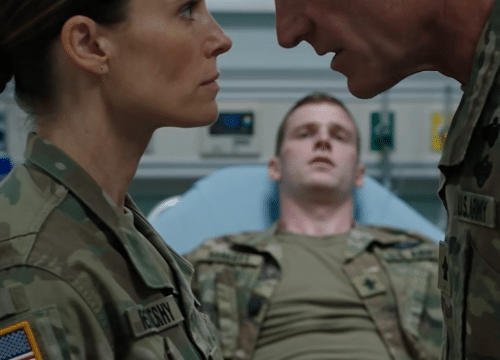
“Then stop humiliating him.”
The exchange had started because of a cadet sitting at the end of the table. Just minutes earlier, Mercer had singled out the young man for supposedly embarrassing him in front of his classmates.
The cadet had apologized twice.
It hadn’t been enough.
Mercer had deliberately knocked the cadet’s tray aside, mocked his performance, and demanded that he stand while everyone else continued eating. The young man had lowered his head, trying desperately to avoid making the situation worse.
Claire had watched long enough.
She was not the highest-ranking officer in the building. She was not the loudest person in the room. But she knew the difference between discipline and cruelty, and she refused to let a uniform become an excuse for either.
Mercer did not appreciate being corrected.
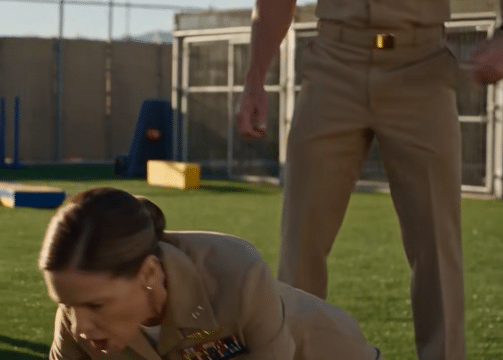
He grabbed the back of her uniform collar and dragged her toward the table.
Before anyone could react, he forced her face down into the food tray.
Then came a brutal slap across her cheek.
Her head snapped sideways. A red mark spread across her skin, and a faint trace of blood appeared at the corner of her mouth.
But Mercer wasn’t finished.
He stepped forward and drove a kick into her stomach.
Claire folded, lost her breath, and fell between the rows of dining chairs.
A fork dropped somewhere behind them.
Nobody moved.
Hundreds of eyes watched as an officer lay on the floor, struggling to breathe while the man responsible stood over her.
Mercer straightened his uniform as if he had merely corrected a minor inconvenience.
Then he delivered the words that would destroy his career.
“Junior officers don’t correct me in front of cadets.”
Claire pressed one hand against her stomach.
She didn’t beg.
She didn’t apologize.
And she didn’t look away.
But Mercer had no idea that someone at the head of the dining hall had witnessed everything.
And that person was about to stand.
Act II
For three years, Captain Daniel Mercer had enjoyed an unusual amount of freedom inside the academy.
He was an instructor with an impressive service record, a reputation for demanding excellence, and a talent for making senior officers believe that his methods produced results.
His cadets rarely complained.
Not because they were satisfied, but because they had learned what happened to people who did.
A poor evaluation could cost someone a recommendation. A disciplinary report could destroy an opportunity they had spent years preparing for. And Mercer knew exactly how to use those fears.
He called intimidation leadership.
He called humiliation accountability.
And he considered every objection a personal challenge to his authority.
Claire Bennett had encountered that attitude before.
At twenty-six, she was among the youngest First Lieutenants assigned to the academy’s duty structure. Her responsibilities included supervising cadet welfare, monitoring disciplinary procedures, and ensuring that instructors followed the institution’s regulations.
She had earned her position through years of demanding work.
Unlike Mercer, she did not measure leadership by how many people lowered their eyes when she entered a room.
She remembered being a cadet herself.
She remembered the instructors who corrected mistakes without destroying confidence. She also remembered the ones who used authority to conceal their own insecurities.
That was why the young cadet’s humiliation had bothered her.
She recognized the expression on his face.
It was not the expression of someone learning from a mistake.
It was the expression of someone who had begun to believe he deserved the treatment he was receiving.
Claire had no intention of allowing that lesson to become part of his education.
Unfortunately, Mercer interpreted her intervention as an attack on his position.
He had expected her to retreat.
Instead, she had challenged him in front of witnesses.
And in Mercer’s world, public disagreement was unforgivable.
What he failed to understand was that Claire had not spoken because she underestimated him.
She had spoken because she understood exactly what he was doing.
Now, as she struggled to regain her breath on the dining hall floor, the cadets who had witnessed the attack began exchanging frightened glances.
Some recognized her as the officer who had quietly helped them through disciplinary problems.
Others had never spoken to her.
But all of them understood one thing.
An instructor had just assaulted a fellow officer in front of an entire dining facility.
And the consequences could be far greater than Mercer imagined.
Then a chair scraped against the floor at the head of the hall.
The Commandant had seen enough.
Act III
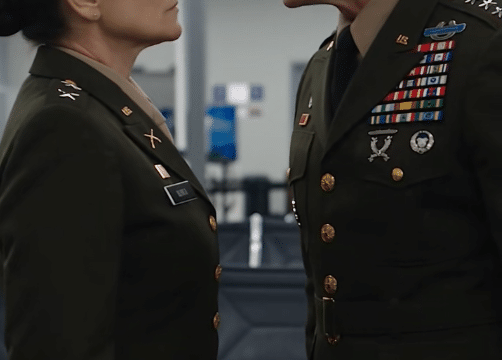
The Commandant was sixty years old, a senior officer whose presence usually brought immediate order to any room.
He had been attending the formal group meal when the confrontation began.
At first, he had watched from a distance, trying to understand why Mercer was arguing with a junior officer.
Then he saw the tray.
He saw Claire’s head forced into it.
He saw the slap.
And finally, he saw her collapse after the kick.
His expression changed.
The cadets closest to him noticed it immediately.
The Commandant slowly rose from his chair.
He did not shout.
He did not wave his arms or demand attention.
He simply stood, and the atmosphere inside the dining facility changed.
Mercer was still standing over Claire when the Commandant spoke.
“Captain… step away from her.”
The words traveled across the hall.
Mercer turned his head.
For a fraction of a second, he seemed annoyed that someone had interrupted him.
He looked toward the Commandant, then back at Claire.
He could have stepped away.
He could have acknowledged the order, allowed the medical staff to assist her, and stopped making the situation worse.
Instead, his pride made the decision for him.
“She needed to learn her place.”
The silence that followed was different from the silence after the assault.
Before, the cadets had been afraid to react.
Now, they were waiting.
Claire slowly pushed herself into a sitting position.
Her stomach still hurt. Her cheek was swollen, and food remained tangled in her dark hair.
But her eyes were clear.
She looked at Mercer, then briefly toward the Commandant.
There was no surprise on her face.
Only disappointment.
Mercer had mistaken her restraint for weakness.
He had mistaken her professional attitude for fear.
And most importantly, he had mistaken her willingness to respect the chain of command for an inability to stand up for herself.
Claire finally spoke.
“You just taught everyone yours.”
The words were quiet.
They were not a threat.
They were not an announcement of revenge.
They were simply the truth.
For the first time since the confrontation began, Mercer seemed unable to find an immediate response.
Because something about the way the Commandant was looking at him suggested that this was no longer an ordinary disciplinary dispute.
There was a reason the senior officer had stood up.
And Mercer was only beginning to understand it.
Act IV
The Commandant stepped forward.
The cadets at the nearest tables immediately straightened in their seats.
Across the dining hall, instructors who had previously pretended not to notice the assault were now watching with unmistakable concern.
Mercer glanced between Claire and the senior officer.
He was searching for an explanation that would allow him to recover control of the situation.
Perhaps the Commandant had misunderstood.
Perhaps he had only seen the end of the confrontation.
Perhaps Claire had provoked him.
But none of those explanations could erase what hundreds of witnesses had just watched.
He had grabbed a female officer by the uniform, forced her face into a meal tray, slapped her, and kicked her to the floor.
Then, when a senior authority ordered him to step away, he had openly defended his actions.
There was no ambiguity left.
Claire remained on the floor, one hand pressed against her abdomen.
A nearby cadet instinctively started to rise, but stopped when she gave him a small, reassuring look.
She did not want anyone else dragged into the confrontation.
The Commandant’s attention remained fixed on Mercer.
His expression was no longer merely stern.
It was controlled anger.
The kind that comes when someone realizes that an institution entrusted to their leadership has allowed an abuse of power to happen in plain sight.
Mercer finally looked at Claire again.
Something about her composure bothered him.
She had been humiliated in front of the entire academy, yet she wasn’t trying to defend her reputation.
She wasn’t demanding an apology.
She wasn’t even asking the Commandant to punish him.
She simply sat there, waiting.
That was when an uncomfortable possibility began to form in his mind.
What if he had completely misunderstood her position?
What if the officer he had treated like an insignificant junior subordinate was someone whose responsibilities extended far beyond his classroom?
He remembered the internal briefings he had barely paid attention to.
He remembered instructions about respecting the academy’s command structure.
He remembered being told that certain duty officers had direct reporting responsibilities to senior command.
But he had never bothered to learn the details.
He had assumed that a young woman in a junior rank could be pushed around without consequence.
Now, with the Commandant standing only a few steps away, that assumption was collapsing.
The entire dining facility seemed to be holding its breath.
And Mercer was running out of places to hide.
Act V
The next few seconds changed the atmosphere of the academy dining hall forever.
Mercer looked at Claire.
Then at the Commandant.
Then back at Claire.
His face had lost the confidence that had defined him only moments earlier.
The realization was becoming impossible to ignore.
He had not merely humiliated a junior officer.
He had assaulted someone under the direct protection of the academy’s senior command structure, in front of the very cadets and instructors who were expected to uphold its standards.
And when he had been given an opportunity to stop, he had chosen to defend himself instead.
Claire slowly lifted her head.
Her cheek still burned.
Her uniform was ruined.
But she remained composed.
The cadets watched her with a different kind of attention now.
They had seen an officer suffer humiliation without surrendering her dignity. They had also seen a man with considerable authority expose the weakness behind his own power.
For years, Mercer had taught them that rank meant the right to command.
Claire had just shown them that rank also meant responsibility.
The Commandant continued to stand at the head of the hall, his attention fixed on the Captain.
Mercer swallowed.
His eyes widened as the final pieces fell into place.
Then, in a voice that barely resembled the confident instructor who had dominated the room moments earlier, he spoke.
“Commandant…?”
His expression was pure disbelief.
The dining hall remained silent.
Because the man who had believed he controlled everyone in that room had finally realized that he had lost control of himself.
And Claire Bennett?
She had never needed to raise her voice to prove her worth.
That afternoon, the cadets learned a lesson no training manual could have taught them:
A uniform can give someone authority. It cannot give them the right to abuse it.
And sometimes, the most powerful thing a person can do is refuse to bow to someone who has forgotten the difference.